Introduction
The cosmetic bag market remains saturated with high-aesthetic designs that suffer from a critical functional failure: structural collapse under partial load. While most products maintain a pristine silhouette when fully packed, the genuine “truth test” of engineering occurs at a 30–50% fill level—the reality for most daily commuters and travelers. When a bag loses its clean lines, folds inward, or tips over due to a lack of independent support, it creates a disorganized user experience that consumers instinctively equate with low-quality construction and “flimsy” brand standards.
This pervasive instability is rarely a consequence of inferior fabric choice; rather, it stems from a fundamental reliance on internal volume pressure instead of calculated structural reinforcement. Expensive PU leather and heavy-gauge nylon often lack the inherent rigidity to counteract gravitational sag without an integrated support matrix. For premium brands, this failure manifests as diminished perceived value and increased return rates driven by reports of “cheap” tactile feedback.
The following analysis deconstructs the mechanics of High-quality cosmetic bag collapse—from base panel dynamics to height-to-width ratios—offering an engineering-led framework for developing structured accessories that remain upright, organized, and premium in appearance, regardless of their internal contents.

1. The “Truth Test”: Structural Integrity at 50% Load Capacity
Most cosmetic pouches maintain a deceptive visual appeal when fully packed as internal volume pressure forces the exterior walls into a taut, idealistic silhouette. The genuine “truth test” of engineering occurs when contents drop to a 30–50% load—perhaps a single foundation bottle, a compact, and a stray lipstick—causing unsupported structures to fold inward, wrinkle, or tip entirely. This structural failure transcends mere aesthetics; for the end-user, a collapsing bag creates a disorganized, frustrating experience, while for the brand, it manifests as diminished perceived value and negative performance ratings citing “flimsiness” or “cheap construction.”
In product testing, we see:
| Fill Level | Soft Pouch Result | Structured Pouch Result |
| 100% | Looks fine | Looks fine |
| 70% | Slight side fold | Stable |
| 50% | Visible collapse | Stable |
| 30% | Fully deformed | Slight tilt |
If a bag only looks good when completely packed, it is structurally dependent on content pressure.
1.1 The Content-Dependency Paradox
Traditional soft-pouch manufacturing relies on the “envelope model” where shape is a byproduct of internal tension rather than independent skeletal support. In these designs, the fabric functions merely as a container that conforms to the geometry of its contents, leading to immediate deformation once the internal pressure disappears. This dependency marks the transition from a premium accessory to a shapeless textile, signaling a lack of intentional structural R&D.
1.2 Material Sophistication vs. Engineering Reality
A common industry misconception suggests that utilizing high-cost PU leather or heavy-gauge nylon automatically guarantees a standing bag. However, without a calculated support matrix, even the most expensive top-grain synthetics exhibit low structural memory and high gravitational sag. True anti-collapse performance is not a function of fabric price but of integrated load management—specifically how the base and walls interact to counteract the downward pull of localized weight.
1.3 The Structural Performance Matrix: Fill Level vs. Silhouette Retention
To quantify the impact of engineering over raw material cost, we evaluate shape retention across three common construction tiers. Our data indicates that a reinforced “Value Tier” bag often outperforms an unreinforced “Premium Tier” bag once the fill level drops below 50%.
1.4 The Impact of “Visual Aging” on Brand Equity
A bag that collapses when half-empty appears prematurely aged and worn, significantly shortening the product’s psychological lifecycle for the consumer. By prioritizing standing stability at low-fill levels, brands can ensure their products maintain a “showroom” crispness throughout daily use, fostering long-term customer loyalty and justifying premium price points through superior tactile and visual durability.
2. Root Cause Analysis: The Mechanics of Structural Failure
Travel cosmetic bags collapse when half-full is a predictable consequence of internal volume pressure dropping below the threshold required to maintain exterior wall tension. When contents fall beneath 50%, the bag ceases to function as a structured vessel and reverts to a shapeless textile, as weight shifts unevenly across an unreinforced base. This instability stems from a fundamental reliance on “content-driven” support rather than engineered internal architecture.
2.1 The Content-Dependency Trap
Many cosmetic pouches utilize a “soft envelope” construction where the fabric merely conforms to the geometry of its cargo. Under full-load conditions, items push outward to create artificial rigidity; however, as items are removed, this outward tension disappears. In product testing, soft pouches exhibit visible deformation—inward folding of top edges and sinking corners—at 30–50% capacity, whereas structured alternatives maintain a consistent profile regardless of internal volume.
2.2 Base Panel Instability and Center-Drop
The base serves as the structural foundation, yet many designs utilize only a single fabric layer or insufficient backing. When a 200g glass foundation bottle is placed in a partially empty bag, gravity concentrates the load on a single point of the base. Without a stiff PP board or EVA sheet to distribute this force, the center of the panel bows downward, pulling the side walls inward and causing the entire structure to destabilize.
Typical deformation pattern:
| Base Type | Result Under 400g Load |
| Fabric only | Bottom curves inward |
| Thin PE board | Slight bend |
| 1mm PP board | Stable |
| 2mm EVA sheet | Very stable |
Many return complaints start with: “It doesn’t stand up on my counter.”That is almost always a base issue.
2.3 The Stability Ratio: Height vs. Width
Proportion exerts a significant influence on standing stability that many brands overlook. When a bag’s height exceeds $1.3\times$ its base width, the center of gravity rises, increasing the risk of tipping as internal items shift. Tall vanity-style bags are particularly prone to “leaning” and “sagging” unless vertical seam reinforcements or high-density foam backings are integrated to counteract the increased leverage of the side panels.
Here is a simple stability reference:
| Base Width | Height | Stability Risk |
| 22cm | 10–12cm | Low |
| 22cm | 14–15cm | Moderate |
| 22cm | 16–18cm | High |
| 22cm | 20cm+ | Very High |
2.4 Zipper Opening as a Structural Break Point
The zipper seam represents a primary failure zone where structural continuity is interrupted. Without a reinforced top-edge strip or a semi-rigid frame beneath the zipper tape, the weight of the hardware and the lack of horizontal tension cause the bag to fold inward along the zipper line. This failure often precedes wall collapse, manifesting as a “pinched” or wrinkled appearance that diminishes the bag’s architectural silhouette.
3. Advanced Material Integration: Hidden Support Systems
To prevent structural failure at low-fill levels, high-performance cosmetic bags must move beyond simple fabric selection toward an integrated support matrix. Most “soft” bags fail because the outer textile lacks the inherent modulus to counteract gravity; true anti-collapse performance requires a multi-layered approach combining outer aesthetics with high-density internal reinforcements.
3.1 The Backing Hierarchy: Enhancing Fabric Modulus
A common industry misconception suggests that thicker outer fabrics, such as 600D polyester or heavy-gauge PU leather, automatically ensure a standing bag. In reality, these materials behave like cloth without secondary backing. Bonding the outer shell to a 2–3mm foam-backed lining or a non-woven interlining significantly increases panel stiffness while maintaining a premium tactile feel. This “bonded-stiffness” prevents the wall-folding common in unreinforced nylon or thin polyester pouches.
3.2 Engineered Internal Reinforcements: EVA vs. PP
Hidden reinforcement panels serve as the bag’s exoskeleton, providing shape retention that fabric alone cannot achieve.
- EVA Sheets (1.5–3mm): Semi-rigid and resilient, EVA is the ideal material for base and wall stabilization in mid-to-high tier products. It offers structural memory—meaning it recovers its shape after compression—and provides a cushioned feel that protects glass foundation bottles.
- PP Boards (0.8–1.2mm): For larger vanity cases or heavy-duty organizers, rigid PP boards offer maximum center-load resistance. By placing a 1mm PP board at the base, the bag avoids the “center-drop” effect where a heavy item causes the bottom to curve and the sides to cave.
- High-Density PE Foam (2–5mm): While EVA provides the “skeleton,” high-density foam acts as the “muscle.” In side-wall applications, foam-backed linings offer superior structural recovery after compression. This allows the bag to be packed flat for shipping but “spring back” to its original standing position immediately upon unfolding—a critical feature for e-commerce brands prioritizing low shipping volumes.
3.3 Lamination and Thermal-Bonding Systems
The method of securing these reinforcements is as critical as the materials themselves. Proprietary thermal-bonding locks EVA or foam inserts between the outer shell and the lining to eliminate the need for bulky, unsightly stitching lines. This “seamless” integration preserves the clean, architectural silhouette of a designer tote bag or high-end cosmetic case while providing a perfectly smooth surface for high-quality brand embroidery or silk-screen logos.
3.4 Weight-to-Rigidity Calibration
Structural engineering in bag R&D is a balance of stability and portability. Utilizing high-density PE foam for side walls provides vertical tension without adding significant weight, ensuring the bag remains “light as air” yet “strong as a box.” Calibrating reinforcement thickness based on the bag’s dimensions allows for a tailored solution where small pouches stay flexible and large organizers stay upright even at 30% load.
Even a well-structured bag can tip if weight shifts to one side.Typical makeup weight distribution:
| Item | Approx Weight |
| Glass foundation bottle | 180–250g |
| Compact | 80–120g |
| Brush | 20–40g |
| Lipstick | 15–25g |
4. Interior Engineering: Load Management and Weight Distribution
Structure isn’t just external; it’s about how the interior manages weight. Without internal segmentation, a 200g foundation bottle becomes a destabilizing force, twisting the base and causing side-wall failure. We solve this through interior engineering—redistributing weight to stabilize the center of gravity and maintain a clean silhouette, preventing the bag from leaning or caving under uneven loads.

4.1 Stabilizing the Center of Gravity with Elastic Retention
Loose items are the leading cause of structural imbalance. Integrating elastic bottle loops or vertical mesh sleeves along the perimeter walls ensures that heavy liquids remain upright and stationary. By securing dense objects against the reinforced side panels rather than allowing them to roll to the center, the bag avoids the “center-sag” effect and maintains vertical tension even when the main compartment is largely empty.
4.2 The Pocket-as-Stabilizer Theory
Internal pockets function as hidden tensioners for the bag’s side walls. Strategic placement of mesh or flat dividers along the interior panels creates lateral reinforcement, effectively acting as an internal “rib cage.” These sub-compartments prevent the soft exterior fabric from folding inward by creating multiple points of tension, ensuring the bag remains standing and accessible rather than collapsing into a shapeless mass.
4.3 Modular Exoskeletons: Removable Structural Inserts
For premium vanity cases and larger organizers, removable inserts provide a secondary layer of structural integrity.
- EVA Structured Trays: High-density EVA inserts create a box-like frame within the bag, preserving its architectural silhouette regardless of the fill level.
- Adjustable Divider Systems: Utilizing foam-padded or felt-board dividers allows for a customizable load-out that reinforces the vertical walls from the inside. These systems allow the bag to retain its “showroom” crispness even at 30% load, significantly reducing consumer complaints regarding “flimsy” or “messy” interiors.
4.4 Strategic Pocket Placement and Load Balancing
Interior pockets are not merely organizational features; they are tension-regulating stabilizers. By placing mesh pockets or elastic dividers precisely against the reinforced side walls, we create a “centripetal load” system. This design forces the weight of foundation bottles and palettes toward the bag’s vertical supports rather than the unsupported center of the base, effectively neutralizing the primary cause of tipping and leaning.
4.5 Strategic Segmentation vs. Open-Volume Failure
Bags featuring a single, large open volume are the most susceptible to collapse due to a lack of internal bracing. Aimazing’s R&D emphasizes a “multi-zone” approach, where internal dividers act as structural pillars. By connecting the base to the top edge through fixed or modular partitions, the internal layout provides the necessary vertical support to keep the zipper line rigid and the corners sharp, even during prolonged real-world usage.
5. Precision Manufacturing: Perimeter and Edge Reinforcement
Structural integrity in cosmetic bags is not merely a matter of interior backing; it is a function of how force is managed at the bag’s transition points. Perimeter reinforcement serves as the primary defense against “visual aging”—the wrinkling and sagging that occurs along the zipper line and corners. By treating the bag’s edges as load-bearing architectural elements, manufacturers can prevent the collapse typical of mass-produced, soft-sided pouches.
5.1 The Zipper Tape as a Structural Vulnerability
The zipper seam represents a critical break in a bag’s continuity where tension is naturally lost. Without reinforcement, the weight of a heavy metal zipper pull or the lack of horizontal support causes the top edge to fold inward at 40% load. Integrating a 1–2mm stiffener strip beneath the zipper tape maintains a rigid horizontal axis, ensuring the bag’s mouth stays open and accessible while preserving its crisp, box-like silhouette during opening and closing cycles.
5.2 Thermal-Bonding vs. Mechanical Stitching
Bulky mechanical stitching does more than just weaken the fabric—it creates messy gathering that screams “mass-produced.” Our thermal-bonding process locks structural foam to the shell without a single visible thread. The result is a seamless, architectural finish that stays smooth under stress. For designer vanity cases, this provides the unblemished surface required for premium logo placement, ensuring your branding isn’t compromised by the unsightly puckering common in low-end manufacturing.
5.3 Vertical Seam Tension and Corner Support
Corners are the first areas to “sink” when internal pressure drops. By utilizing reinforced vertical piping or hidden HDPE (High-Density Polyethylene) strips within the side seams, the bag gains a vertical “pillar” effect. This engineering strategy transfers the load from the top edge directly to the reinforced base, preventing the inward bowing common in taller vanity-style silhouettes where height-to-width ratios are high.
5.4 Durability Against Cycle Fatigue
Structural tension must survive repeated real-world usage. Soft-wall bags often show visible deformation after 500+ opening cycles as the fabric stretches and fibers lose their memory. Aimazing’s manufacturing process focuses on preload tensioning—ensuring the outer fabric is pulled taut over the internal reinforcements—to maintain “showroom” crispness throughout the product’s entire lifecycle, effectively reducing return rates driven by reports of “flimsiness” after a few weeks of use.
6. Quality Assurance of Cosmetic Travel Bag
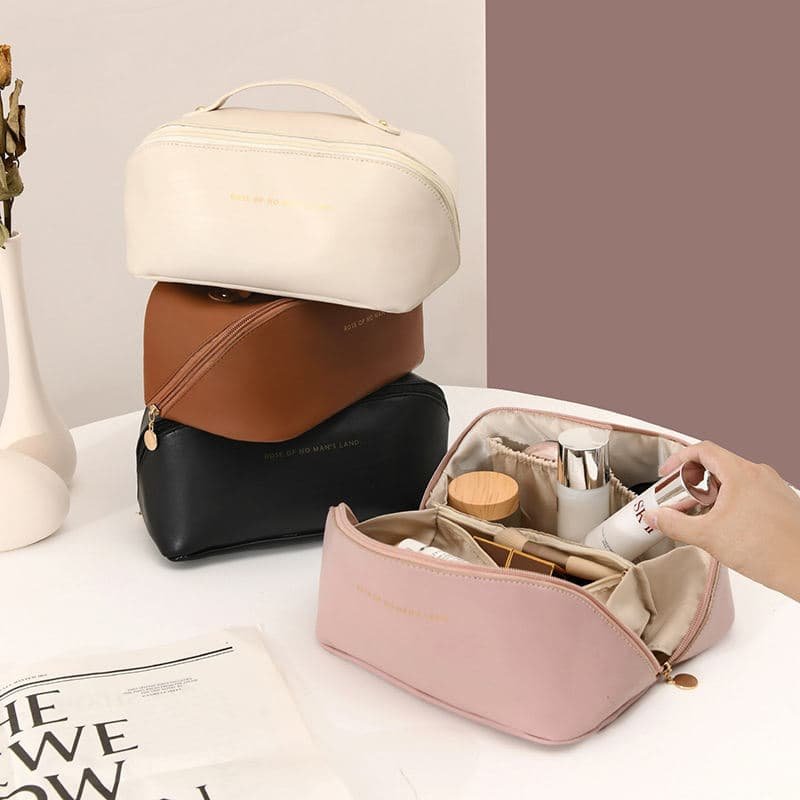
Structural engineering remains theoretical until validated through rigorous simulation of real-world partial-fill conditions. Standard full-load inspections often mask inherent structural weaknesses that only manifest when internal volume pressure is absent. A comprehensive stability protocol must evaluate the bag’s performance at 30–50% capacity to ensure the architecture survives the “truth test” of daily usage.
6.1 The 15° Tilt and Static Load Observation
The primary benchmark for standing stability involves placing a half-filled bag (containing approximately 300–500g of realistic weight, such as a glass foundation bottle and a compact) on a flat surface. Gradual tilting of the surface to a 15° angle reveals whether the center of gravity is sufficiently managed. Bags lacking a reinforced EVA base or strategic interior segmentation will exhibit immediate “leaning” or “sliding,” signaling a high risk of tipping on a bathroom vanity or dressing table.
6.2 Accelerated Fatigue and Opening-Cycle Testing
Structural tension must endure repeated mechanical stress. Utilizing a 500+ cycle open-close test allows engineers to observe if the zipper tape or top-edge stiffeners lose their horizontal rigidity over time. Soft-wall pouches without foam backing typically show visible “pinching” or permanent wrinkling along the zipper line after 200 cycles, whereas pre-tensioned reinforced designs maintain their crisp, architectural lines.
6.3 Edge Compression and Corner Drop Analysis
Simulating the chaotic environment of a travel tote requires corner-drop tests from heights of 60–80cm. This analysis identifies if the internal reinforcements—such as PP boards or EVA sheets—stay locked in place or shift, causing permanent silhouette distortion. A successful test proves that the thermal-bonded internal framework provides enough “memory” for the fabric to recover its original shape immediately after impact.
6.4 Environmental Stress and Structural Creep Testing
High-performance polymers, particularly PU and TPU, can soften under high humidity or temperature, leading to “structural creep.” Aimazing conducts thermal-chamber testing (up to 45°C/80% RH) to ensure that internal adhesives and EVA reinforcements do not lose their bonding strength or rigidity in tropical climates, ensuring the bag maintains its crisp silhouette from the factory floor to the global consumer’s vanity.
6.5 Aimazing’s Engineering-Led Validation
With 26+ years of R&D, Aimazing’s stability-first process involves structural compression and cycle-fatigue checks. We focus on load-management engineering rather than just fabric thickness, ensuring even mid-range products exhibit premium performance.
Conclusion
Preventing structural collapse is far more than a minor fix—it is a sophisticated engineering challenge that directly impacts a brand’s bottom line. A bag that loses its shape prematurely is a liability; it signals a lack of quality to the consumer regardless of the material cost.
True success in this category is found in the “internal exoskeleton.” When the modulus of the fabric is correctly paired with high-density reinforcements, the result is an architectural statement that remains upright throughout its entire lifecycle.
At Aimazing, we don’t just manufacture bags—we engineer confidence. We help our partners redefine the structured accessory, ensuring every product is resilient, refined, and perpetually upright.