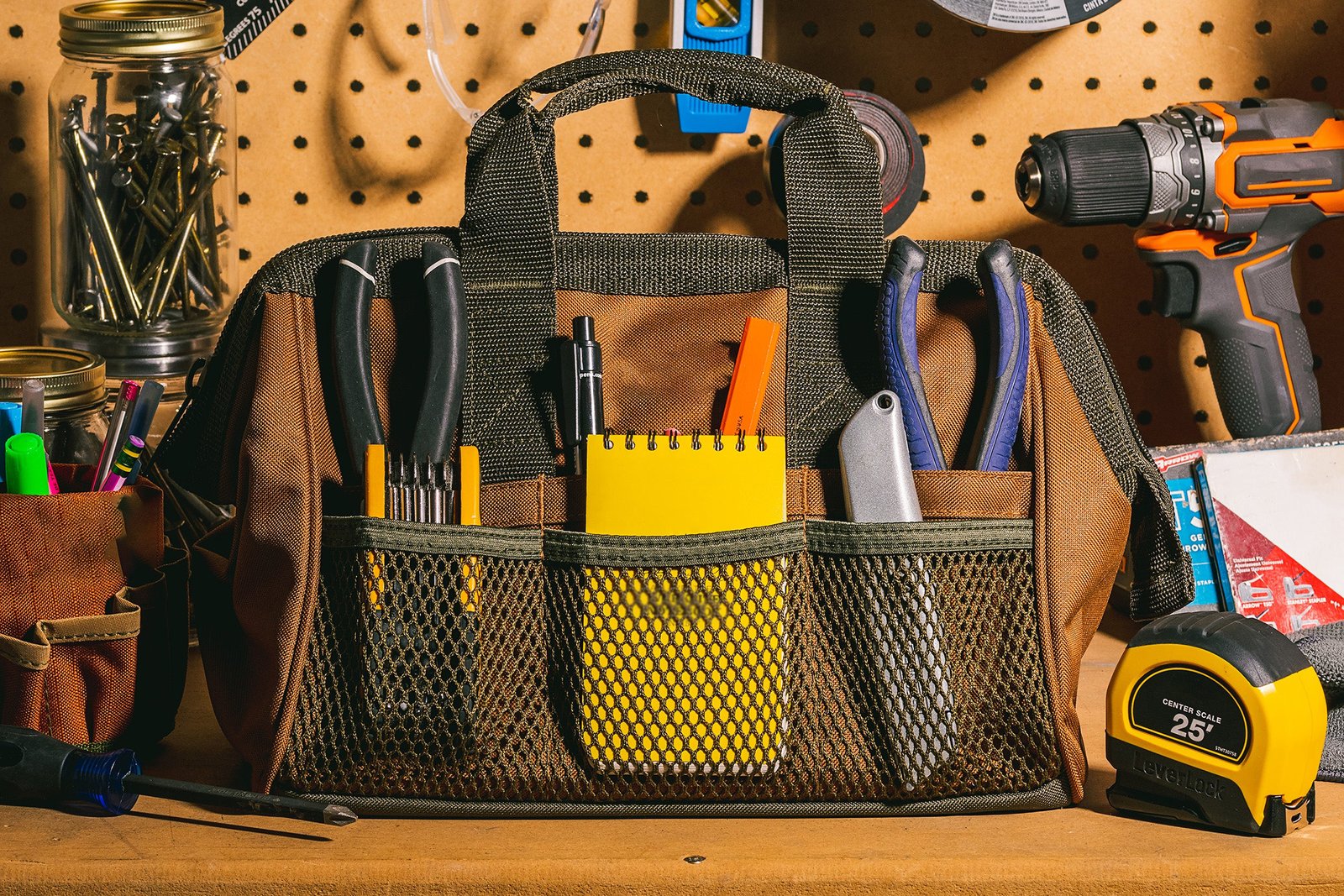
1. Introduction: The High Stakes of Tool Storage
In the demanding world of professional trades, a tool bag is far more than a textile pouch—it is a critical component of a technician’s mobile infrastructure. Whether you are an HVAC specialist, an electrician, or a heavy-machinery mechanic, the durability of your gear carrier directly dictates your operational uptime. A structural failure on a remote job site—such as a burst seam or a collapsed base—does more than just spill tools; it risks damaging expensive precision instruments and compromises site safety.
Choosing a professional tool bag requires a shift in perspective: from viewing it as a “soft good” to treating it as an “engineered vessel.” The following analysis deconstructs the essential features that allow a bag to remain stable and indestructible through years of abuse.
1.1 The “Static vs. Dynamic” Load Challenge
A tool bag rarely fails when sitting still on a workbench; failure occurs during the “Dynamic Transition”—the moment you lift 25kg of steel off a truck bed.
- Kinetic Impact: A sudden lift generates a momentary force up to 1.5x the actual weight.
- Load-Path Engineering: A bag engineered for professional standards must have a reinforced path that transfers this energy from the handle, through the side-ribs, and into the molded base.
1.2 Structural Memory and Skeletal Support
Without an internal frame or high-density interlining, the fabric stretches unevenly under load. Over time, this “Fiber Fatigue” weakens the textile’s modulus, causing the bag to lose its upright shape and become a “floppy” liability. At Aimazing, we prioritize “Skeletal Stability” to ensure the bag keeps its form even when half-empty.
2. Material Science: What Material is Best for a Tool Bag?
The “DNA” of a bag’s longevity lies in its primary textile. When evaluating what material is best for a tool bag, we must look beyond surface aesthetics and analyze tensile strength, puncture resistance, and denier count. The choice of material determines whether the bag will survive a puncture from a stray chisel or the constant friction of a concrete floor.
| Material Type | Technical Characteristics | Best Use Case |
| Ballistic Nylon (1680D) | Military-grade weave; extreme puncture resistance. | Tool bag backpacks for heavy-duty use. |
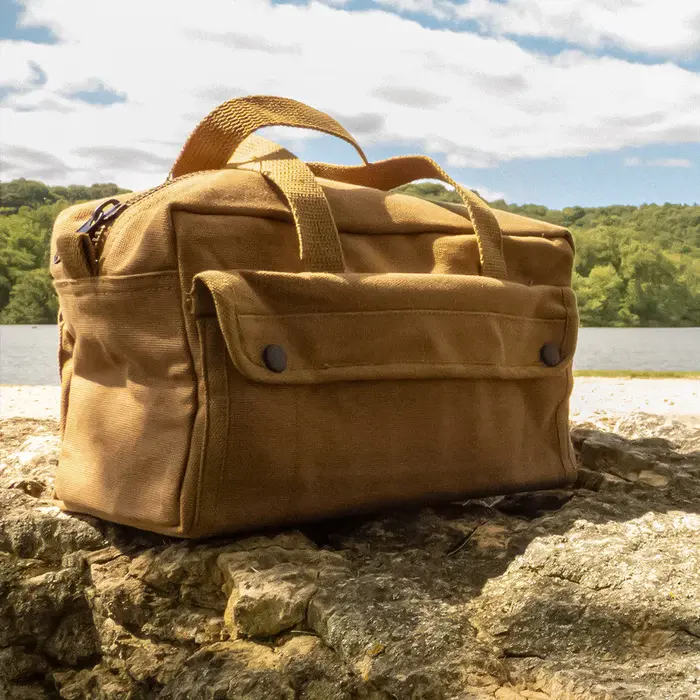
| Heavy-Duty Canvas | High abrasion resistance; “breathes” to prevent moisture. | Traditional canvas tool bag for plumbing/masonry. |
| Top-Grain Leather | Naturally spark-resistant; high frictional durability. | Premium leather tool bag or electrician’s tool pouch. |
| High-Density Polyester | Low stretch; excellent UV and chemical resistance. | Top-rated waterproof tool bags for outdoor use. |
2.1 Quantifying Durability: The Martindale Metric
When determining the optimal textile, engineers look at “Double-Rub” cycles. 1680D Ballistic Nylon typically withstands 50,000+ double-rubs. Its basket-weave structure ensures that even if a single fiber is severed, the surrounding weave “locks” the tear, preventing a catastrophic rip.
2.2 TPU Lamination vs. Surface Coatings
For top-rated waterproof tool bags for outdoor use, we prioritize TPU (Thermoplastic Polyurethane) internal lamination. Unlike cheap PVC coatings that crack or “cold-crack” in winter, TPU is a permanent fuse that ensures the bag remains 100% water-impermeable throughout its entire lifecycle.
3. The Mechanics of Reinforced Stitching
In a load-bearing utility bag, the fabric rarely fails first; the thread does. To handle the weight of a full socket set, the stitching must be engineered for “Stress Distribution.” Standard stitching is a vulnerability; reinforced stitching is a structural necessity.
3.1 Bar-Tack Reinforcement at Stress Zones
At every “Vulnerability Point”—where a pocket meets the main wall or a strap attaches to the body—a high-density bar-tack stitch (42+ stitches per inch) is essential. This prevents localized tearing when the bag is hoisted under maximum load.
3.2 Anti-Chafe Internal Seams
In a big tool bag, internal seams can rub against tool edges, leading to “Internal Abrasion.” Every raw edge inside an Aimazing-engineered bag is bound with high-tenacity tape. This eliminates frayed edges and creates a “Girdle Effect,” reinforcing the bag’s structural corners from the inside out.
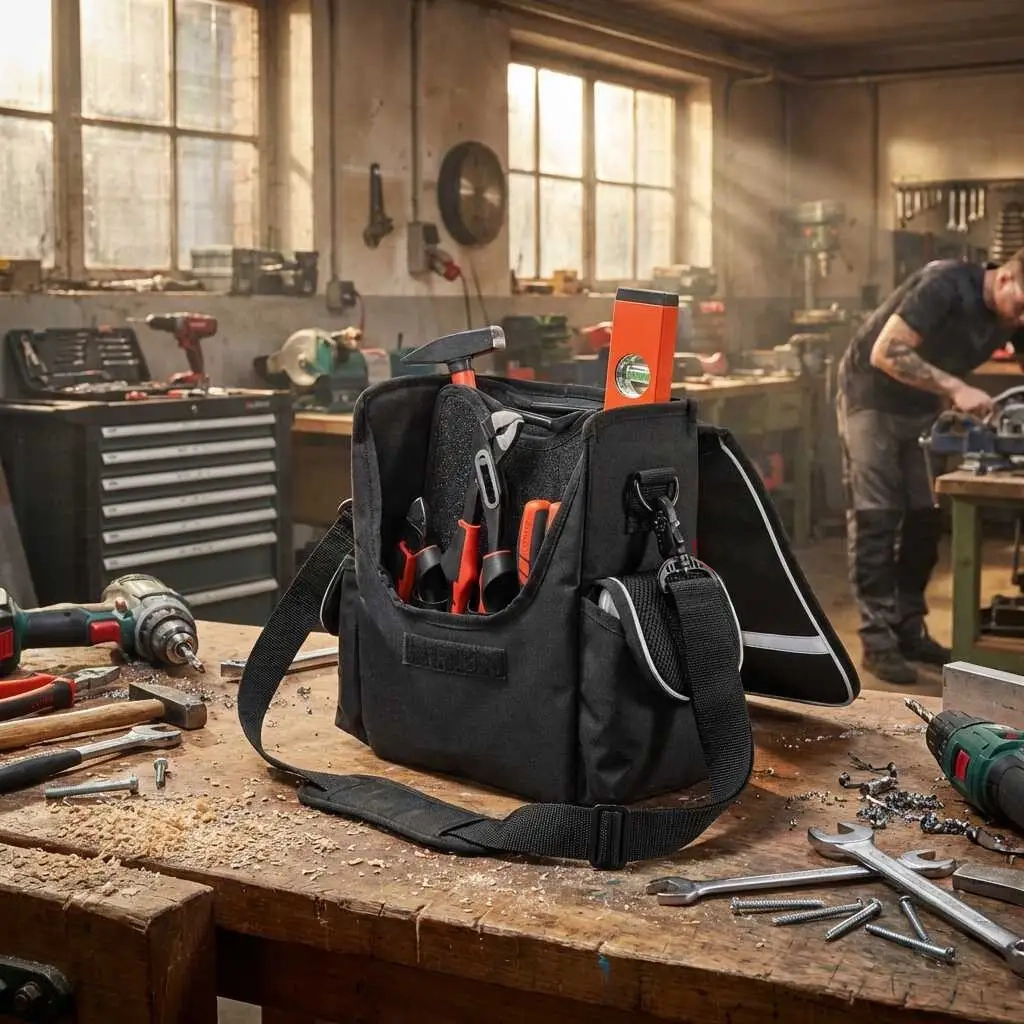
4. Internal Architecture: Organization as a Shield
Durability is not just about raw strength; it’s about “Organizational Longevity.” When tools tumble freely, they act like a “milling machine” inside the bag, grinding down the fabric. A well-organized interior is the first line of defense against internal wear.
4.1 The Pocket-as-Stabilizer Theory
Internal pockets function as hidden tensioners. Strategic placement creates lateral reinforcement, acting as an internal “rib cage” that prevents the soft exterior fabric from folding inward when the bag is only half-full.
4.2 Centripetal Load Management
Integrating elastic loops or vertical sleeves ensures that heavy items remain stationary. By securing dense objects against the reinforced side panels rather than the unsupported center, the bag avoids the “center-sag” effect and maintains vertical equilibrium.
5. Hardware Integrity: Zippers and Closures
The zipper is the most cycled component of the bag. A failed zipper renders a professional tool bag useless, regardless of fabric strength. Choosing the right mechanism is a matter of longevity.
5.1 Oversized YKK Hardware
We recommend #10 or #12 gauge zippers for main compartments. These “Big-Teeth” zippers are less susceptible to jamming from job-site dust and metal shavings compared to standard consumer-grade hardware.
5.2 Wide-Mouth “Gated” Design
Internal metal stays (hinges) keep the bag mouth open while you work. This “Stay-Open” feature prevents the zipper tape from being stressed or pinched by a collapsing bag mouth, extending the closure’s life by up to 300%.
6. Reinforced Bottoms: The Hard-Shell Foundation
The base endures “Impact Fatigue” every time it is set down on gravel or mud. Without a reinforced foundation, a tool tote bag will eventually “bottom out,” leading to holes and moisture ingress.
6.1 Molded Waterproof Bases
A 3mm-thick polypropylene (PP) base is essential for top-rated waterproof tool bags. It creates a “Moisture Moat” that keeps tools dry even if the bag is sitting in standing water.
6.2 The “Moat” Effect: Chemical Resistance
Construction sites are often contaminated with diesel or corrosive solvents. A molded PP base is inert to these chemicals, creating a 5cm “Safe Zone” that a standard canvas tool bag cannot provide, ensuring the textile remains pristine.
7. Ergonomics: Comfort and Strength Combined
Transporting a 20kg kit across a site requires an interface that prevents user fatigue. Affordable tool bags with shoulder straps for easy carrying must prioritize “Load-Path Engineering.”
7.1 The Load-Path Advantage of Backpacks
For vertical transport (ladders, scaffolding), tool bag backpacks are the gold standard. They utilize a sternum strap and hip belt to transfer 60% of the weight to the user’s pelvis, protecting the lower back from chronic strain.
7.2 Closed-Cell EVA Padding
We utilize closed-cell EVA foam in handles and straps. Unlike open-cell foam, it doesn’t “bottom out” under weight, maintaining its cushioning over years of heavy-duty use.
8. Climatic Resilience: UV and Thermal Engineering
Durability isn’t just about friction; it’s about surviving the elements. High-performance bags must be tested for “Environmental Stress.”
8.1 UV and Fade Resistance
Prolonged exposure to sunlight can “cook” synthetic fibers, making them brittle. High-end polyester bags treated with UV-resistant coatings maintain their tensile strength, crucial for best utility bags for outdoor activities.
8.2 Cold-Crack Resistance
Standard PVC-backed materials will “Cold-Crack” at -10°C, causing the bag to shatter like glass. Top-rated waterproof tool bags use specialized TPU blends that remain flexible down to -40°C, ensuring structural integrity in arctic conditions.
9. Quality Assurance: The Engineering Validation Matrix
Structural engineering remains theoretical until validated through rigorous simulation of real-world job site stress. At Aimazing, we move beyond simple visual inspections to “Destructive Testing” protocols that identify failure points before mass production.
9.1 The Dynamic Drop Test (The “Tailgate” Simulation)
A professional tool bag backpack or big tool bag must survive an accidental drop from a height of 1.5 meters while fully loaded (approx. 25kg). We analyze high-speed footage of the impact to ensure the molded PP base absorbs the kinetic energy without cracking and that the handle’s bar-tack stitching does not exhibit “fiber elongation.”
9.2 Cycle-Fatigue and Hardware Stress Testing
Hardware failure is the most common cause of B2B returns. Our quality protocol includes:
Zipper Cycle Testing: 5,000+ open-close cycles in a dust-chamber to simulate five years of job site grit.
Tensile Seam Testing: Applying sustained force to the main seams to measure the “modulus of rupture”—ensuring the canvas tool bag or leather tool bag maintains its structural “skeletal” integrity even under 200% of its rated load.
Click on the video below to see how we conduct bag tests. At the same time, you can click here to watch more information about quality inspection.
9.3 The B2B Development Matrix: Balancing BOM and Performance
For brands determining how to choose a tool bag for their product line, we provide a strategic decision matrix:
| Component | Economy Tier | Professional Tier | Aimazing Ultra-Pro (Benchmark) |
| Primary Fabric | 600D Polyester | 1200D Nylon | 1680D Ballistic Nylon + TPU |
| Internal Framing | None (Soft-wall) | Foam-backed | Integrated PE Plate / Steel Stay |
| Closure System | Standard Nylon | #8 YKK Zipper | #10/12 Oversized Industrial YKK |
| Impact Buffer | None | 2mm PE Foam | 5mm High-Density EVA Shielding |
| Foundation | Double-layer fabric | Padded Webbing | 3mm Molded Polypropylene Base |
10. Versatility and Multi-Functionality: The Adaptive Ecosystem
Modern trade work is rarely static. A bag that cannot adapt to changing tasks is a liability. Versatility in a professional tool bag is achieved through modular architecture that allows a technician to customize their carry for specific phases of a project.
10.1 The “Hub and Spoke” Modular System
The most efficient storage utilizes a modular approach. You bring the big tool bag to the staging area (The Hub) and detach a specialized tool pouch or tool tote bag (The Spoke) for specific tasks, such as overhead electrical work. This reduces user fatigue and prevents unnecessary wear on the larger vessel.
10.2 External Expansion (MOLLE & Attachment Points)
Drawing from tactical load-bearing gear, high-performance tool bag backpacks now incorporate MOLLE (Modular Lightweight Load-carrying Equipment) webbing. This allows for the external attachment of a drill holster or a secondary canvas tool bag, expanding capacity without compromising the bag’s primary center of gravity.
11. Conclusion: Engineering the Future of Tool Storage
Choosing the most durable tool bag for professional needs is an exercise in material physics and load-path management. As we have deconstructed, a bag’s lifespan is not dictated by its price, but by the calculated balance of its reinforced base, supported side walls, and high-tenacity stitching.
The “indestructible” checklist for professionals:
- 1.Foundation First: Always demand a molded hard-shell base to mitigate chemical and moisture damage.
- 2.Verify the Hardware: Ensure oversized zippers and metal D-rings are integrated into the load-path.
- 3.Prioritize the “Skeletal” Build: Look for internal stays and EVA reinforcements that prevent the bag from buckling when half-empty.
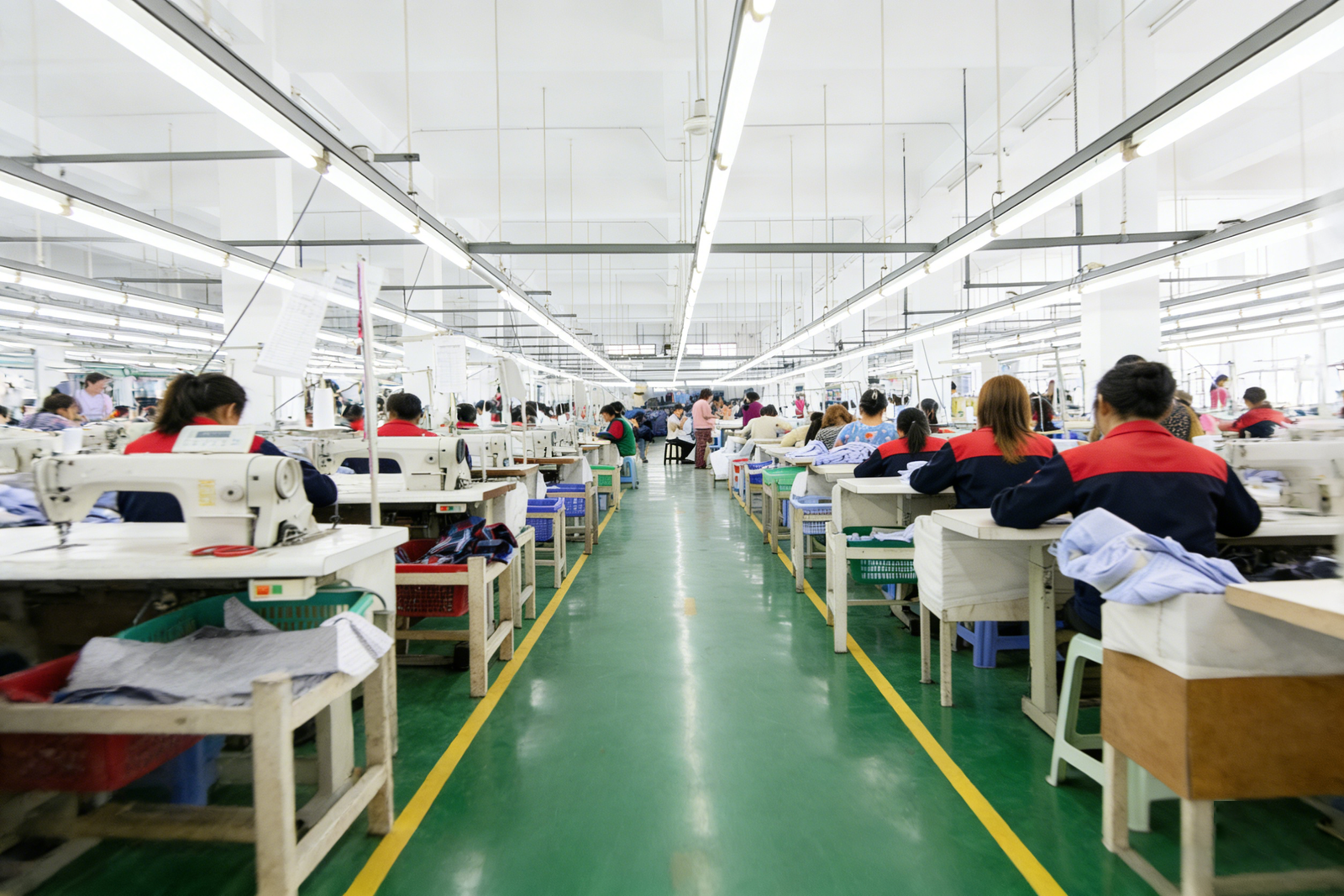
At Aimazing, we don’t just manufacture bags—we engineer confidence for the men and women who build the world. Ready to redefine your professional gear? Contact Aimazing today to leverage our 26-year R&D history and develop a proprietary tool storage solution that stands as strong as your reputation.
Looking to develop a proprietary tool bag collection that dominates the global market? Contact Aimazing today to leverage our engineering-led manufacturing and redefine what professional gear can be.