1. Introduction: What Is a Can Cooler and Why the Market Is Growing
Understanding what is a can cooler requires looking beyond simple beverage sleeves toward the broader engineering of thermal management. The special beverage cooler can effectively resist the high temperatures of the environment and the radiation of the sun, while also preventing the cold air from harming the user’s hand grip. It is highly popular in the global market, which not only reflects the growing popularity of outdoor leisure activities among people at present, but also indicates the continuous demand of people for high-performance and durable equipment. This cooler provides important thermal insulation against ambient heat and solar radiation while preventing condensation from reaching the user’s hand. Rapid expansion within the global market reflects both the increasing popularity of outdoor leisure activities and a consistent shift toward high-performance, durable equipment. Leading brands recognize that modern consumers want excellent performance can cooler solutions that maintain a consistent temperature in extreme conditions – not just cheap, novelty products.
Market Drivers and Consumer Expectations
Outdoor Lifestyle Expansion: Rising participation in camping, boating, and tailgating drives global demand for ruggedized drink cooler solutions engineered for high demand.
Functionality: Modern users prioritize ergonomic grip and non-slip bases while seeking to define what is a can cooler through the lens of professional-grade utility.
Market Segmentation by Utility
| Segment | Primary Use Case | Key Requirement |
| Leisure | Backyard BBQs / Social gatherings | Aesthetic variety and ease of use |
| Adventure | Marine / High-heat environments | Maximum thermal retention and durability |
| Promotional | Corporate events / Brand awareness | Cost-effectiveness and print surface area |
2.The Origins of the Beer Koozie
Tracing the evolution of beer koozies, they have advanced far beyond simple bar essentials to become professional drink accessories integrated with cutting-edge insulation technology. Initially popular as basic beer hand cozies, their core purpose was to keep users’ hands dry while holding a drink. Today, they have evolved into high-tech drink insulators crafted with cutting-edge materials science. In the early stage of designs were purely focused on boosting user comfort, while modern versions prioritize optimized insulation performance — all to keep beverages at the perfect temperature from the first sip to the last. From simple beer cups to elaborately crafted beverage insulation cups, this transformation clearly demonstrates the continuous improvement in technology and craftsmanship in the beverage accessory industry.
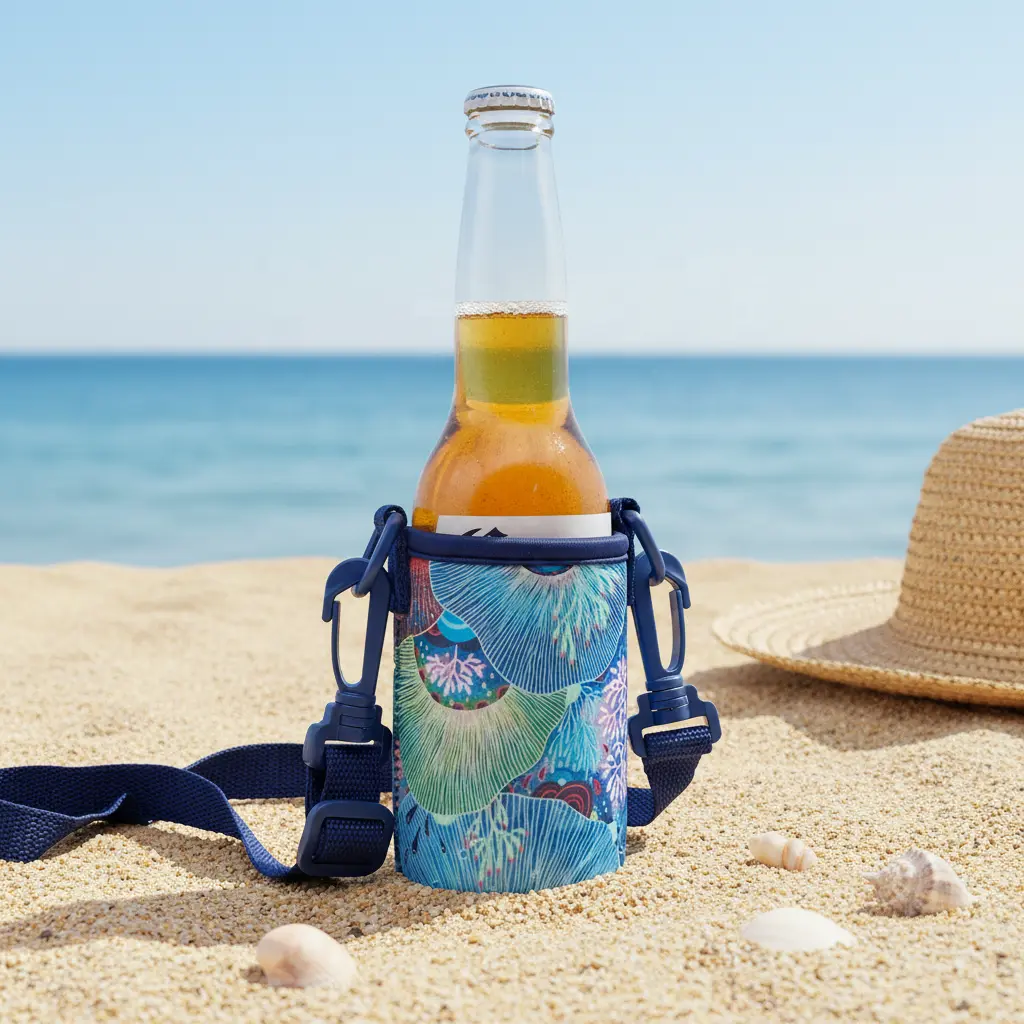
Evolution of Barwear Technology
- The Early Era: Basic foam sleeves designed for moisture absorption rather than genuine temperature control.
- The Neoprene Shift: Adoption of diving-grade materials to improve the insulating properties of the standard beer koozie.
- The Modern Standard: Integration of rigid shells and vacuum seals to move beyond traditional barwear.
Key Historical Milestones
- Late 1970s: First patent filings for cylindrical beverage insulators.
- 1980s Pop Culture: The beer koozie becomes a staple of American tailgating and collegiate culture.
- 2010s Material Revolution: Transition from soft-sided foam to double-walled vacuum insulation.
3.Is It a Koozie, Coozie, or Beer Sleeve?
The ongoing debate over the spelling—coozie or koozie—often confuses consumers searching for reliable beer and drink sleeves. While Koozie is a registered trademark, the industry uses a variety of terms—including beer sleeve and drink sleeve—to refer to this one functional product. When the buyer asks, “Is this a cozy or a koozie?”, their confusion often stems from language differences in different regions: the same product can have many different names, ranging from a container insulator to a cold drink storage container.
When you can precisely grasp these linguistic nuances, it will help you accurately identify the positioning that matches the customers and cleans the products, enabling you to accurately attract global search traffic.
Regional and Industry Terminology
- North America: Common usage of drink koozie and “can cooler.”
- Australia: Dominance of the term “stubby holder.”
- United Kingdom: Frequent use of “stubby jacket” or “bottle cooler.”
Common Naming Variations
| Term | Origin/Type | Context |
| Beer Sleeve | Functional Descriptor | Used primarily in manufacturing and e-commerce |
| Koozie | Trademarked Brand | Often used as a genericized trademark in the US |
| Beer Cozy | Traditional | Refers to knitted or fabric versions |
| Stubby Holder | Regional | Standard Australian terminology |
4. What Is the Point of a Can Cooler?
Determining what is the point of a can cooler involves analyzing the intersection of thermodynamics and user experience. A can cooler is primarily what is a can cooler used for when a user needs to minimize the “K” value, or thermal conductivity, between the environment and the drink. Beyond temperature, what is a can cooler called when it functions as a protective barrier against denting or as a method for identifying one’s drink in a crowd. The core objective remains the mitigation of heat gain from the hand and the atmosphere to ensure the beverage remains refreshing for the duration of consumption.
Primary Functional Objectives
- Thermal Barrier: Engineered thermal barriers enhance beverage retention by maintaining temperatures 50% colder than uninsulated counterparts over 20-minute intervals.
- Condensation Control: Absorbing or preventing “sweat” to maintain a dry grip and protect surfaces.
- Mechanical Protection: Providing a layer of cushioning to prevent container damage during outdoor use.
User Benefits Matrix
- Temperature Maintenance: Engineered thermal barriers keep beverages up to 50% colder over a 20-minute duration compared to uninsulated containers.
- User Comfort: Dual-purpose insulating layers eliminate physical discomfort during extreme temperature exposure while ensuring a secure grip on both sub-zero and high-heat containers.
- Identification: Integrated custom colors and distinct graphic designs facilitate rapid beverage identification in social or high-traffic environments.
5. How Do Can Coolers Keep Drinks Cold?
Explaining how can coolers maintain low beverage temperatures requires an examination of insulating materials functioning as an insulated beverage holder. A high-quality insulated drink holder traps stagnant air surrounding the container to minimize heat transfer. This layer of trapped air significantly slows convection and conduction processes that otherwise rapidly warm the beverage. Professional insulated beverage holder designs incorporate metallic reflective layers to deflect radiant heat away from the internal container.
Thermal Management Mechanisms
- Conduction Mitigation: Engineered thermal barriers disrupt the direct transfer of kinetic energy from warm hands to cold containers.
- Convection Reduction: Protective layers shield containers from moving air currents that accelerate temperature equalization.
- Radiant Heat Reflection: Metallic or specialized internal coatings deflect solar radiation to minimize thermal absorption from direct sunlight.
Material Thermal Performance
- Polyurethane Foam: Low-cost open-cell structures provide effective air-trapping properties.
- Closed-Cell Neoprene: Denser material configurations offer superior moisture resistance and structural durability.
6.Which Beer Koozie Works Better?
The hard-shell beverage cooler combines both cold preservation efficiency and portability. It is made of injection-molded plastic or double-layer vacuum-sealed steel. By optimizing the structure and materials, it enhances protection and blocks heat conduction at its source, achieving efficient cold preservation.This rigid architecture ensures prolonged internal temperature stability at the cost of dedicated storage requirements that restrict user mobility during transit. Such systems remain the standard for stationary outdoor environments or marine applications where thermal performance outweighs the need for lightweight transport.
Comparative Material Analysis
| Metric | Foam (Polyurethane) | Neoprene (SBR/CR) |
| Durability | Low; prone to tearing | High; maintains shape for years |
| Insulation | Moderate | Superior |
| Portability | Excellent (Collapsible) | Good (Slightly denser) |
| Water Resistance | Absorbs liquids | Naturally hydrophobic |
Why Neoprene Prevails in Premium Markets
- Structural Precision: Neoprene’s inherent elasticity ensures a tight grip on the container to eliminate thermal air gaps.
- Surface Fidelity: The smooth material substrate facilitates high-definition custom graphics for superior branding clarity.
- Material Integrity: Specialized synthetic rubber resists crumbling and degradation far more effectively than standard polyurethane foam alternatives.
7. Slim Can Coolers and Modern Beverage Trends
The rise of the slim can cooler mirrors the explosive growth of the hard seltzer and energy drink markets. As consumers move away from traditional 12oz cans, the slim can cooler has become an essential beverage cooler for those drinking “tall and skinny” cans. A cool can experience now requires a specialized fit that prevents the smaller diameter container from rattling or falling out. Successful brands have pivoted their beverage cooler strategy to include dedicated slim-fit designs to capture this younger, health-conscious demographic.
The Seltzer Effect on Inventory
- Market Demand: Hard seltzers and premium energy drinks have normalized the 12oz slim can format.
- Fit Precision: Slim cans require a significantly narrower internal diameter to maintain thermal contact.
- Aesthetic Trends: Slim can cooler designs often feature more vibrant, fashion-forward colors.
Key Design Specifications
- Internal Diameter: Optimized for 2.25-inch cans vs. the standard 2.6-inch.
- Height Calibration: Slightly taller to cover the full surface area of the elongated can.
- Tapered Bases: Often designed to fit into standard car cup holders.
8. Hard-Sided vs Soft-Sided Can Coolers
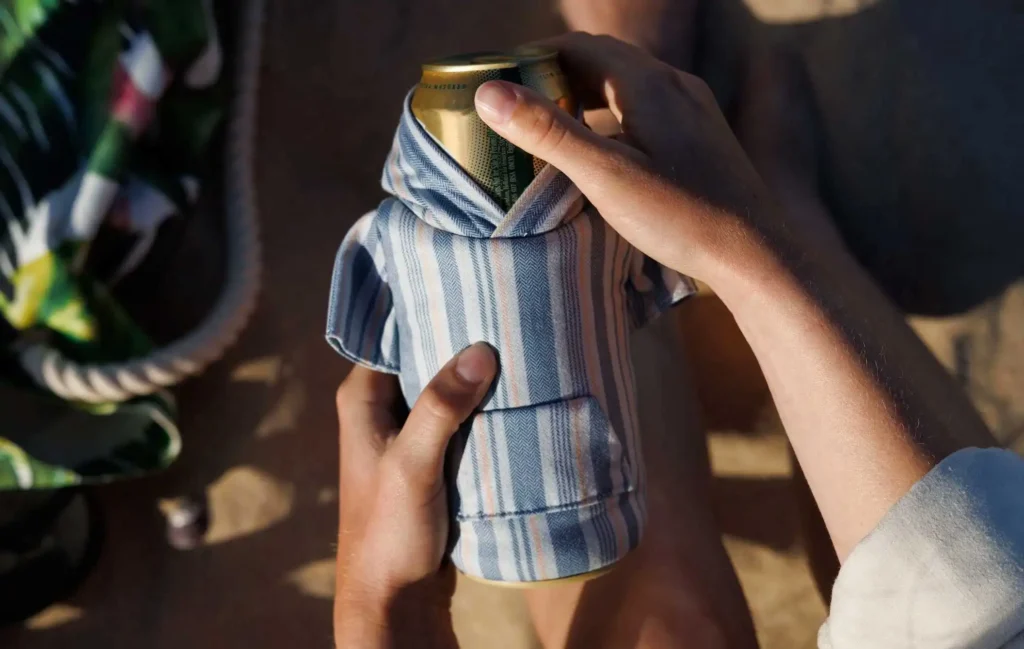
Market-available beverage coolers primarily bifurcate into hard-shell and soft-shell models defined by the inherent trade-off between thermal efficiency and physical portability. The increased structural mass of hard-shell units yields superior cooling performance at the necessary expense of increased weight and spatial requirements. The soft-shell canned beverage cooler that is most suitable for travel mainly uses high-density chloroprene rubber. This material enables it to have both portability and the effect of reducing weight, making it convenient for people to carry and use.
Performance Comparison Table
| Feature | Hard-Sided (Steel) | Soft-Sided (Neoprene/Foam) |
| Cold Duration | 6 – 12 Hours | 30 – 60 Minutes |
| Weight | Heavy (9-12 oz) | Ultra-light (1-2 oz) |
| Collapsibility | None | High (Fits in pocket) |
| Price Point | Premium ($20+) | Budget ($1 – $10) |
Selecting the Right Option
- For the Beach: Hard-sided steel prevents sand from sticking and keeps drinks cold in direct sun.
- For Air Travel: Soft-sided neoprene is essential for saving luggage space and weight.
- For Tailgating: A mix of both allows for maximum performance and easy distribution to guests.
9. Portable Beverage Coolers for Outdoor and Travel Use
The portable beverage cooler has undergone iterative upgrades and is specifically designed to fit the dynamic lifestyle. It continuously optimizes to meet the market’s demand for sturdy and lightweight solutions. It needs to strike a precise balance between efficient storage and mechanical durability that can withstand strong impacts. The modern model also incorporates an integrated climbing buckle design, allowing for hands-free movement during transportation and making it more convenient to carry around.
Travel-Ready Features
- Ergonomic Grip: Textured surfaces and ergonomic indents prevent slippage during activity to ensure a secure grip.
- Lightweight Materials: Composite plastics and thin-gauge steel minimize fatigue through lightweight material utilization.
- Compatibility: Targeted design dimensions ensure universal compatibility with bike cages and car cup holders.
Outdoor Mobility Factors
- Attachment Points: Integrated attachment loops facilitate seamless integration with tactical gear. Silicone-reinforced bases prevent shifting on unstable surfaces like boat decks or uneven terrain.
- Non-Slip Bases: Optimized material science provides corrosion-resistant, easy-clean surfaces that effectively repel mud, sand, and saltwater.
- Easy-Clean Surfaces: Materials that resist mud, sand, and salt-water corrosion.
10. Specialized Premium Segments: Puffer Styles
The evolution of drinkware accessories now encompasses specialized niches tailored to fashion-forward preferences. Moving beyond basic utility, these designs prioritize advanced aesthetic textures.
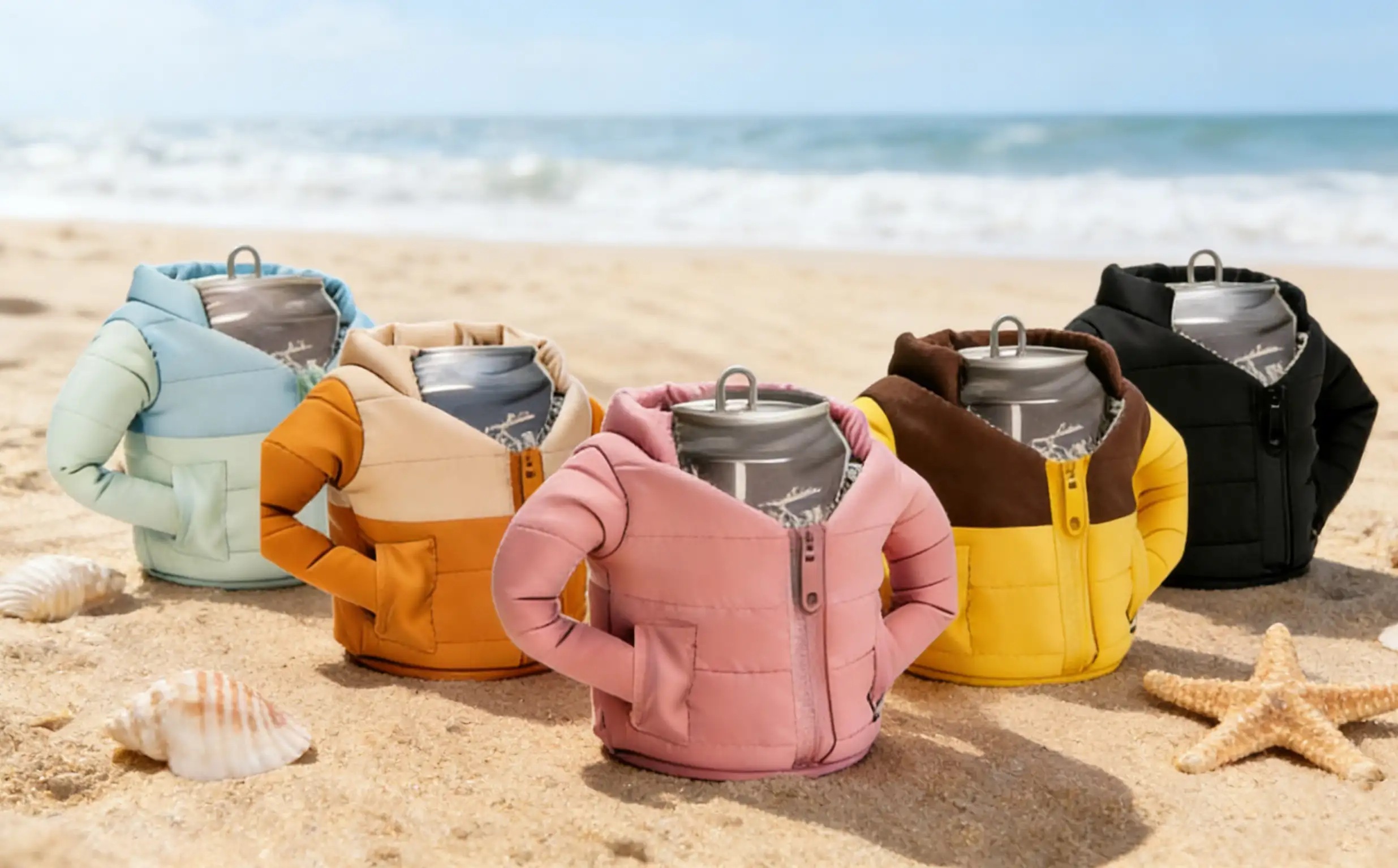
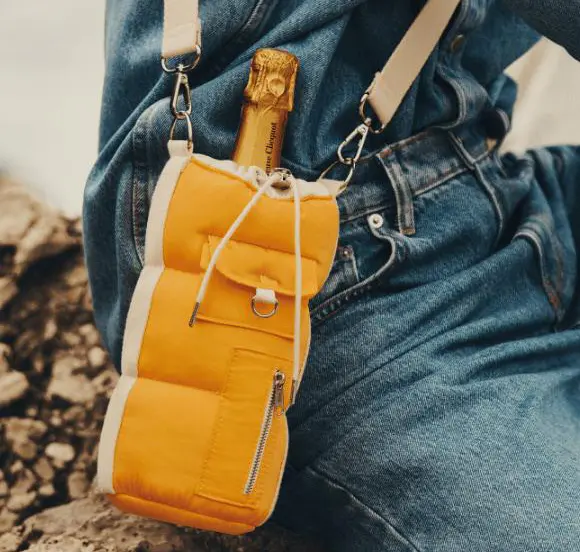
Puffer Style Coolers: These units apply high-fashion quilting techniques to thermal insulation. High-density water-resistant textiles paired with performance-grade synthetic insulation create a thermal shield that doubles as a tactile lifestyle accessory, redefining the beverage container as a curated personal style statement.

This multi-layered design is inspired by high-end outerwear. It wraps a thermal core with a water-repellent outer shell, and uses a quilted layer that can trap air to regulate the temperature gradient, thereby minimizing heat exchange with the outside world. This high-performance insulation design is integrated with the practical attributes of streetwear, making outdoor equipment an exclusive extension to showcase one’s personal brand philosophy.
11. Custom and Personalized Can Coolers: The Promotional Market
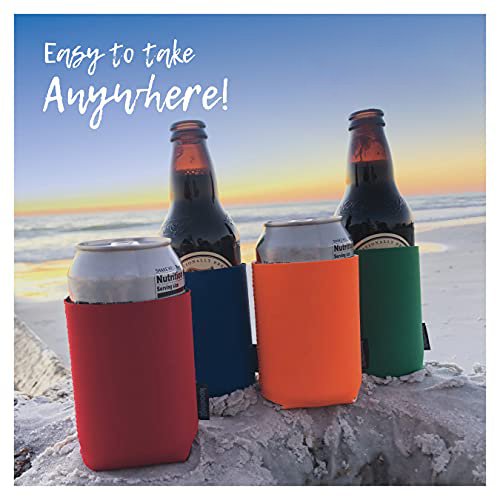
The custom beer koozie remains a highly effective tool within the promotional products industry due to its superior impressions-per-dollar ratio. The personalized custom can cooler comes with a unique transparent display surface, which not only allows for clear presentation of the brand logo and event slogans, but also has practical functions. Compared to traditional disposable paper marketing materials, it enables users to use it for a longer period and continuously achieve promotional effects. When professional buyers customize beer cup sleeves, they will prefer to use high-quality screen printing or laser engraving techniques to ensure that the brand logo will not fall off or fade over time.
The Power of Promotional Cooling
- High Retention: 80% of consumers keep promotional drinkware for more than a year.
- Mass Appeal: Everyone has a use for a cooler, regardless of their beverage of choice.
- Low Unit Cost: Soft-sided coolers offer a very low entry point for bulk marketing.
Customization Methods
- Screen Printing: Best for high-volume, cost-effective multi-color logos on foam or neoprene.
- Sublimation: Allows for full-color, edge-to-edge photographic prints on white polyester-faced neoprene.
- Laser Engraving: The premium choice for stainless steel, providing a permanent, sophisticated look.
12. Are Insulated Sleeves Still Relevant in Today’s Market?
Retailers often ask where can I find durable insulated sleeves for beverage cans and whether these traditional products can compete with high-tech steel. Despite the rise of vacuum insulation, soft insulated sleeves remain highly relevant for their affordability and portability. When searching for where can I find durable insulated sleeves for beverage cans, buyers are often looking for the “everyday” solution that can be thrown in a pocket or a glove box. These products bridge the gap between no protection and the high-cost barrier of premium steel coolers.
Why Soft Sleeves Persist
- Affordability: Low cost makes them accessible for large parties and giveaways.
- Ease of Storage: Can be flattened and stored in drawers or pockets.
- Vibrant Design: Neoprene allows for unlimited color and pattern variations that are harder to achieve on steel.
Sourcing Quality Sleeves
- Seam Construction: Look for “zigzag” stitching rather than simple glue to ensure longevity.
- Material Thickness: 3mm to 5mm neoprene provides the best balance of insulation and flexibility.
- Bottom Design: “No-bottom” or “tucked-bottom” designs affect how the can sits on a flat surface.
13. Can Coolers and Temperature Science: Vacuum Insulation Explained
Understanding how do vacuum-insulated can holders maintain temperature requires knowledge of the three types of heat transfer: conduction, convection, and radiation. A vacuum is an empty space where virtually no atoms exist which means heat cannot move via conduction or convection. This explains how do vacuum-insulated can holders maintain temperature so effectively compared to foam. By eliminating the air between two walls, the heat from a user’s hand or the sun has no medium through which to travel, creating a nearly perfect thermal barrier for the beverage.
The Physics of the Vacuum
- Eliminating Conduction: No solid material connects the inner and outer walls, stopping heat flow.
- Eliminating Convection: No air exists between the walls to circulate heat.
- Radiant Heat Control: Internal copper or silver linings reflect infrared radiation.
Thermal Performance Benchmarks
- Foam/Neoprene: Maintains “cold” (below 45°F) for approximately 45 minutes.
- Standard Double-Wall: Maintains cold for 2 to 4 hours.
- Premium Vacuum-Insulated: Maintains cold for 6 to 12 hours depending on ambient temperature.
14. Should You Put a Can Cooler in the Freezer?
A common question for users is do you put can coolers in the freezer to enhance their performance. For soft-sided foam or neoprene, there is little benefit as these materials do not have much thermal mass to hold the cold. However, for certain gel-filled coolers, the answer is yes. For stainless steel, the answer to do you put can coolers in the freezer is generally no; the vacuum insulation that keeps heat out also prevents the cold from the freezer from getting in. Furthermore, extreme cold can potentially damage the seals or gaskets on premium steel units.
Freezer Compatibility Guide
- Soft Foam/Neoprene: Safe but ineffective.
- Gel-Lined Coolers: Designed specifically for the freezer to provide active cooling.
- Stainless Steel: Ineffective and potentially damaging to the vacuum seal.
- Best Practices for Pre-Chilling
- Cold Drinks First: The most effective way to keep a drink cold is to ensure it is at the desired temperature before insertion.
- Shadow Play: Keep your cooler out of direct sunlight to maximize its efficiency.
- Gasket Check: Ensure the top ring is tight to prevent cold air from escaping and warm air from entering.
15. What Do British People Call a Koozie?
Language differences often lead to the question what do british people call koozies or what do british call a cooler. In the UK, the term “Koozie” is far less common; instead, people may refer to them as “stubby jackets,” “can cosies,” or simply “insulated sleeves.” When asking what do british call a cooler, it is important to note that “cooler” in the UK often refers to a large ice box (a “cool box”). For the individual beverage holder, they tend to use more descriptive, less branded terminology than their American counterparts.
UK vs. US Terminology Table
| US Term | UK Equivalent |
| Koozie | Can Cosy / Stubby Jacket |
| Cooler (Box) | Cool Box |
| Seltzer | Alcoholic Sparkling Water |
| Tailgating | Not commonly practiced (closest is “pre-match drinks”) |
Linguistic Nuances for International Sourcing
- Cosy vs. Cozy: Note the “s” vs “z” spelling in Commonwealth English.
- Stubby: Refers to a short, 330ml bottle, common in the UK and Australia.
- Jacket: A common suffix for any protective or insulating sleeve.
16. What Makes the Most Effective Can Coolers for All-Day Cold Drinks
To determine what are the most effective can coolers for keeping drinks cold all day, one must look at the synergy of materials and seal integrity. The most effective can coolers for keeping drinks cold all day utilize a combination of deep-vacuum insulation, copper plating, and a high-quality airtight gasket. Without a proper seal at the top, cold air escapes through the “chimney effect,” significantly reducing performance. Successful brands focus on this top-down thermal management to ensure that the last sip is as cold as the first, even hours after opening.
The Hierarchy of Effectiveness
- Vacuum-Insulated Steel (with Copper Lining): Best for 6+ hours of cold.
- Gel-Infused Plastic: Good for active cooling of room-temperature drinks.
- High-Density Neoprene: Best for short-term (1 hour) use and portability.
Critical Design Pillars
- Airtight Gasket: Prevents ambient air from circulating around the can.
- Copper Coating: Acts as a radiant heat shield within the vacuum space.
- Wall Thickness: Optimizing the gap between steel layers to maximize the vacuum’s effectiveness.
17. Why Most Can Cooler Designs Fail
Most can koozie failures stem from a lack of attention to “fit and finish” which leads to poor thermal performance. A drink cooler fails when the internal diameter is too large, creating an air pocket that allows for heat exchange, or when the beverage cooler uses low-density foam that compresses over time. Furthermore, many designs fail by ignoring the “human factor”—creating a can koozie that is too wide to hold comfortably or too tall to allow for easy drinking. These engineering oversights turn a potentially great drink cooler into a frustrating user experience.
Common Sourcing Pitfalls
- Poor Material Density: Using cheap, airy foam that offers zero thermal resistance.
- Insecure Gaskets: Rings that strip their threads or pop off when the can is inserted.
- Unstable Bases: Narrow bottoms that cause the beverage to tip over on uneven surfaces.
Mechanical Failure Points
- Seam Splitting: Poorly glued or stitched seams in soft coolers.
- Vacuum Leakage: Micro-cracks in steel welds that “kill” the insulation properties.
- Paint Peeling: Low-quality powder coating that chips after a few uses.
18. What Successful Brands Do Differently
Successful brands in the insulated can cooler market differentiate themselves through technical innovation and a focus on specialized niches like the portable beverage cooler. By offering a high-quality custom beer koozie option for corporate clients and high-performance insulated can cooler units for outdoor enthusiasts, these brands build a multi-layered market presence. They prioritize “The Frictionless Experience”—ensuring the can is easy to load, the grip is comfortable, and the thermal performance exceeds expectations.
Strategies of Market Leaders
- Niche Specialization: Creating specific sizes for 16oz “tallboys,” 12oz slims, and 12oz standards.
- Multi-Functional Innovation: Pioneering 3-in-1 and 4-in-1 designs that simplify the consumer’s life.
- Brand Ecosystems: Ensuring the portable beverage cooler matches the aesthetic of their larger coolers and drinkware.
The “Successful Brand” Checklist
Lifetime Warranty: A sign of confidence in the vacuum seal and material durability.
- Proprietary Gasket Tech: Innovative ways to secure the can without struggling.
- Consumer Engagement: Utilizing custom beer koozie programs to build community and brand loyalty.
19. Conclusion: The Future of Beverage Insulation
The evolution of the beverage cooler market reflects a sophisticated shift from novelty “beer sleeves” to high-performance thermal hardware. Modern consumer demand is currently dictated by three core pillars: thermal efficiency, ergonomic portability, and niche aesthetic customization.
- Thermal Engineering: The transition from simple foam to double-walled vacuum insulation represents the industry’s most significant leap in performance, allowing for multi-hour temperature retention.
- Segmented Utility: Success in this market requires a clear distinction between stationary, high-performance steel units used in marine or camping environments and lightweight, collapsible neoprene alternatives optimized for travel and promotional volume.
- Design Precision: Failure in cooler design is typically rooted in “fit and finish” oversights—such as poor internal diameter calibration or inadequate gasket seals—which compromise the vacuum integrity and user experience.
Ultimately, leading brands are winning by bridging the gap between professional-grade utility and lifestyle-driven design. As the market expands, the ability to provide modular, durable, and highly personalized cooling solutions will remain the primary driver of consumer loyalty and competitive advantage.