With sub-6GHz and high-frequency millimeter-wave (mmWave) 5G networks now being the global standard, traditional signal-blocking bags are hitting a wall. Many procurement managers and e-commerce brands are learning the hard way that shielding designs built for 3G or 4G completely leak modern 5G signals. Sticking with these outdated specs is a fast track to soaring return rates and ruined buyer trust. In this guide, we’re skipping the fluff and exposing why entry-level shielding bags fail. Drawing from 26 years of hands-on OEM/ODM bag manufacturing experience, we’ll dive straight into raw material specs, factory testing methods, and practical production insights to ensure your premium protective gear actually blocks the signal and keeps your inventory moving.
1. The 2026 Shielding Crisis: Why 5G Networks are Wrecking Badly Made Faraday Bags
1.1 High-Frequency Penetration: The Physical Challenge of 5G and mmWave Signals
Modern telecommunication systems operate within expanded high-frequency spectrums that render low-tier industrial shielding products completely ineffective. While historical 3G and 4G LTE architectures utilized relatively long radio wavelengths below 2.5 GHz, modern deployments introduce sub-6GHz bands and high-frequency millimeter-wave spectrums extending from 24 GHz up to 40 GHz. These high frequencies exhibit short wavelengths that easily exploit microscopic gaps within loose textile weaves or non-conductive stitching tracks.
When an internal metal lining features uneven mesh spaces or minor thread separations, high-energy wave vectors easily pass through the barrier layer, establishing immediate device-to-station data link synchronization. For a functional bag developer, providing protection in this high-frequency environment requires moving past old material configurations toward ultra-dense, multi-layered metalized textiles capable of continuous surface charge redistribution under high radiation loads.
1.2 The Reputation Risk: How a Failed Order Destroys Brand Trust
Sourcing a batch of protective pouches that fail real-world validation introduces a severe liability that can permanently damage a brand’s market placement within a single product launch cycle. When an enterprise attempts to rely on a manufacturer whose product documentation lacks certified radio frequency attenuation data, they risk distributing products that leak signals under modern network conditions.
[Defective Component Batch] -> Signal Leakage -> Rapid Consumer Returns -> Algorithmic De-ranking -> Brand Attrition
In the current transparent digital marketplace, negative user feedback regarding product performance spreads rapidly across international distribution channels. A single consumer video proving a device can still receive an active cellular ping while inside a sealed pouch immediately undermines product integrity. This algorithmic de-ranking prompts immediate order cancellations from large B2B distributors and leads to expensive inventory liquidations that permanently damage corporate profitability.
2. Back to Basics: What is a Faraday Bag and How Does It Actually Work?
2.1 The Electromagnetic Shield: Explaining the Faraday Cage Principle to Modern Consumers
To successfully pitch security luggage to global procurement managers, you need a clear, fluff-free way to explain how a Faraday bag actually protects data. At its core, this functional gear relies on the classic Faraday Cage principle. We line the inside of the bag with a continuous, unbroken layer of highly conductive metallic fabric. The moment an external radio wave—whether it’s 5G, Wi-Fi, or RFID—hits this conductive barrier, the free electrons within the metal mesh instantly rearrange themselves. This creates an immediate counter-field on the surface that completely neutralizes the incoming signal, leaving the interior of the bag a total wireless dead zone.
Incoming Radio Wave -> Hits Conductive Mesh Lining -> Instant Surface Charge Realignment -> Interior Signal Blocked Completely
2.2 Whats a Faraday Bag Core Defense Layer? Decoding the Continuous Conductive Mesh
When analyzing whats a faraday bag core protective component, technical evaluation reveals that shielding success is dictated by the structural continuity of the conductive mesh layer. A genuine high quality faraday bag does not rely on simple metalized spray coatings or loose carbon fibers; instead, it uses a multi-layered fabric base woven with pure ionic copper and high-purity nickel filaments. This metallic yarn must maintain close contact across both the warp and weft directions, ensuring a low-resistance path for the electrical currents generated by incoming RF energy. If this conductive layer is broken by substandard sewing methods, the shield fails, transforming a technical product into a standard nylon pouch.
3. The 5G Vulnerability: Why Most Faraday Bags for Phones Leak Signals Today
3.1 The DB Attenuation Trap: Why 40dB is No Longer Enough for a Modern Faraday Bag for Phone
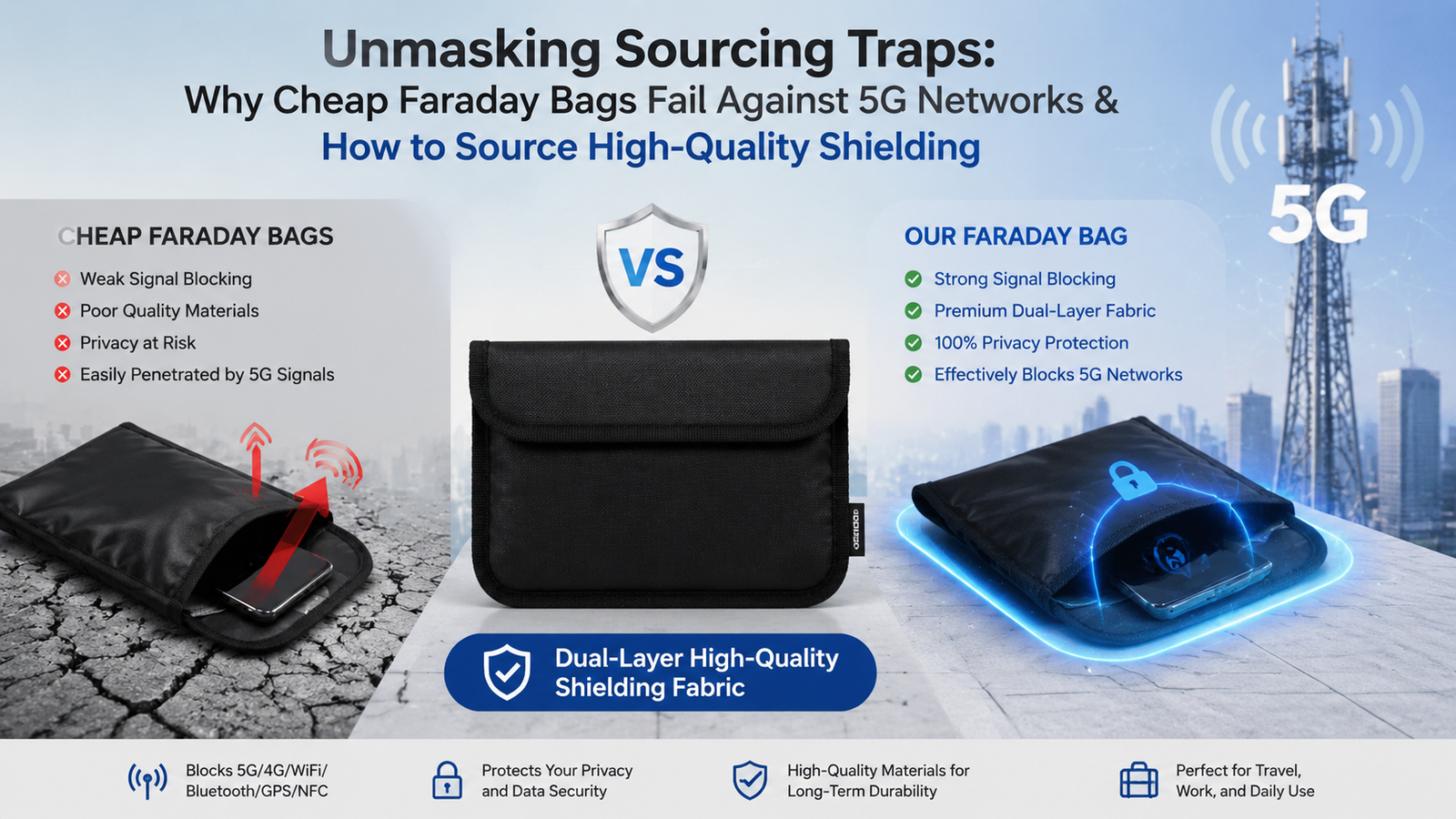
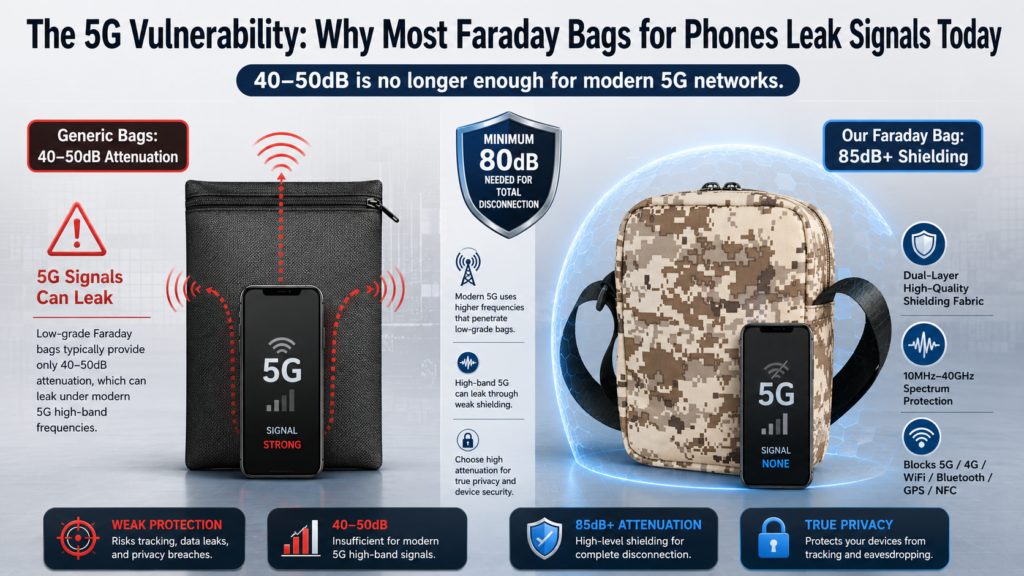
The primary failure point for entry-level consumer signal pouches is a reliance on low-level decibel (dB) attenuation ratings that are unsuited for the power output of modern cellular networks. Generic faraday bags for phones are typically engineered to deliver an average attenuation of 40dB to 50dB across narrow bands. While this is sufficient for blocking distant, low-power 3G base station signals, it is entirely insufficient against modern high-density networks.
While generic faraday bags for phones only achieve 40-50dB attenuation—which easily leaks under 5G high-band frequencies—a true high quality faraday bag engineered by a professional leather bag manufacturer requires dual-layer ionic silver or nickel-copper fabrics, delivering over 85dB attenuation across a 10MHz to 40GHz spectrum.
A modern smartphone located close to a high-power cellular tower requires an absolute minimum shielding threshold of 80dB to guarantee total disconnection, making a high-dB attenuation rating a baseline requirement for high-stakes privacy applications.
3.2 Sourcing for 2026: The Mandatory Transition to 80dB+ Multi-Layer Shielding
Sourcing functional security items in 2026 requires transitioning your product catalog to include certified multi-layer shielding matrices that deliver an attenuation rating of 80dB or higher across all major communication frequencies.
- The Layered Matrix: Utilizing two or more separate layers of high-density nickel-copper woven fabric separated by an insulating polymer layer.
- Reflective Capacity: This layered approach ensures that any residual electromagnetic leakage that passes through the outer conductive layer is completely reflected and absorbed by the inner shield.
- Spectrum Isolation: Delivering complete isolation across all active communication channels, including GPS tracking frequencies, high-frequency 5G bands, and common commercial WiFi spectrums.
4. The Sourcing Illusion: Debunking the Aluminum Foil Faraday Bag Myth
4.1 Metal Foil vs. Plated Textiles: Why an Aluminum Foil Faraday Bag Cracks and Fails After 10 Folds
An aluminum foil faraday bag configuration represents a significant quality risk within the international supply chain. While solid aluminum foil sheets provide good electrical conductivity in static lab settings, they possess very low mechanical flexibility.
When an end-user opens, closes, or folds an aluminum foil faraday bag just 10 to 15 times during daily use, the metallic layer develops microscopic stress fractures along the fold lines. These small fractures break the continuous path of electrical conductivity, allowing high-frequency radio waves to pass through the compromised sections and rendering the product completely ineffective.
4.2 Industrial Weaving: Why Nickel-Copper Fabrics Stay Conductive Under Real-World Stress
To survive the everyday wear and tear of travel and daily use, a Faraday bag’s protective core cannot rely on fragile metal foils that crack the first time the customer folds the bag. It takes high-performance plated textiles to do the job right.
- Precision Electroplating: Before the weaving process even begins, individual polyester microfibers go through a rigorous electrochemical plating process, locking in uniform layers of pure copper and protective nickel. We build the conductivity right into the very DNA of the thread.
- Built to Bend: This advanced yarn setup gives the conductive fabric incredible flexibility. The bag can handle thousands of tight creases, deep folds, and heavy mechanical rubs on the production line and in the field without developing micro-cracks or leaking signals.
- Zero Rust, Zero Oxidation: The outer nickel layer acts as a shield for the highly conductive copper core inside, keeping ambient moisture and skin oils from causing oxidation. This means your inventory won’t degrade while sitting in a warehouse, and the end consumer gets the same flawless signal-blocking performance years down the road.
5. Consumer Skepticism: Do Faraday Bags Work in Real-World Environments?
5.1 The Truth Behind the App Test: Why Bluetooth Disconnection Doesn’t Mean Cellular Blocking
One of the biggest headaches for e-commerce brands is dealing with buyers who try to test their gear at home and immediately wonder: do faraday bags work the way they’re advertised? A classic mistake users make is tossing a phone inside the bag to see if their Bluetooth earbuds cut out. Here’s the catch: Bluetooth runs on a low-power 2.4 GHz frequency that almost any basic foil or cheap metallic lining can block. Passing a quick Bluetooth test doesn’t mean a thing when it comes to stopping aggressive pings from a nearby cell tower or localized 5G network. Blocking those heavy-duty cellular signals takes a whole different level of shielding density to achieve total isolation.
5.2 Do Faraday Bags Work Against Modern Base Station Pings? The Factory Verdict
From our factory’s testing laboratory, the answer to do faraday bags work against high-density infrastructure is dependent on production precision.
- The Ping Challenge: Modern base stations emit high-power, directional pings designed to penetrate deep into residential buildings and vehicles.
- The Industrial Solution: To block these aggressive signals, a product must feature verified 85dB+ attenuation backed by spectrum analyzer data, moving beyond simple consumer testing apps toward objective, laboratory-certified performance metrics.
6. Automotive Cybersecurity: Sourcing the Ultimate Faraday Bag for Key Fob Protection
6.1 Amplified Relay Attacks: How Thieves Exploit Smart Keys from 50 Meters Away
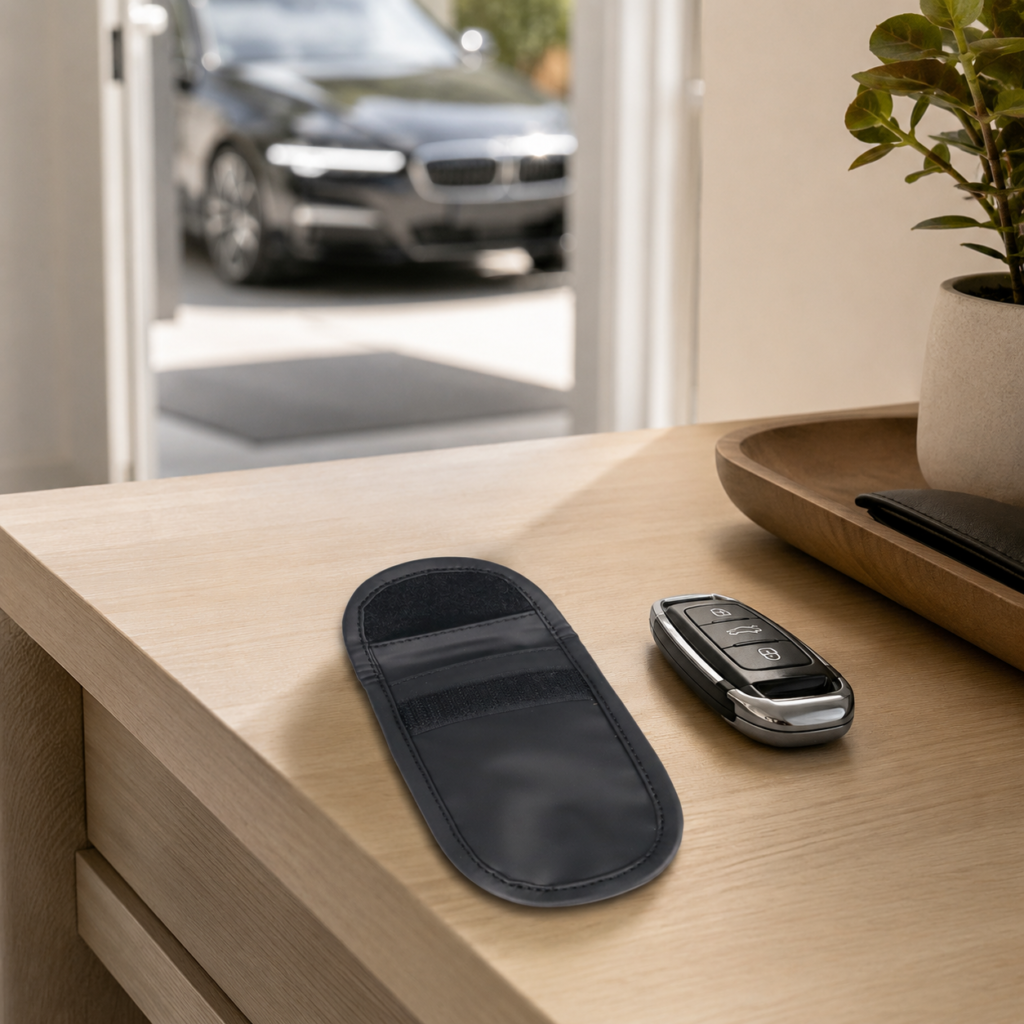
The automotive sector faces a significant security challenge from “Relay Attacks,” where thieves use high-gain transponders to capture and amplify the low-power wireless pings emitted by smart key fobs inside a home. This amplified signal allows an accomplice standing next to the vehicle to open and start the car in seconds without causing physical damage. This widespread security vulnerability has created an urgent global demand for a dependable faraday bag for key fob protection, turning a niche item into a required household accessory for premium vehicle owners.
6.2 Precision Customization: Engineering a Long-Lasting Faraday Bag for Car Keys for Luxury Auto Brands
Sourcing a faraday bag for car keys collection for premium automotive dealerships or security brands requires an absolute focus on seam geometry and component longevity.
- Volumetric Precision: Designing internal dimensions that match specific key fob sizes, ensuring the pouch closes securely without bunching.
- Reinforced Hardware: Utilizing heavy-duty magnetic tracking or high-cycle hook-and-loop fasteners to maintain a consistent seal over thousands of operations.
- Material Premium: Combining premium top-grain leather outers with an interior faraday bag for key fob lining, delivering high-end style alongside certified digital security.
7. The Smart Home Era: The Explosion of the Faraday Bag for WiFi Router Segment
7.1 Managing Radiation and Signal Overload: The Sourcing Demand for Large-Scale Shielding Bags
The expansion of smart home devices has created a growing market segment focused on environmental radiation management. Many consumers seek a faraday bag for wifi router enclosures to minimize their exposure to ambient electromagnetic radiation during sleep hours without turning off their home network hardware. Sourcing these oversized shielding bags requires balancing high attenuation with structural flexibility, as the pouch must fit over various router geometries without straining the conductive seams or blocking incoming power cables.
7.2 Heat Dissipation vs. Signal Lock: The Engineering Challenge of a Faraday Bag for WiFi Router
Manufacturing an effective faraday bag for wifi router enclosure introduces a unique thermal engineering challenge that standard bag workshops cannot solve.
- The Heat Risk: Active routers generate substantial heat that can cause device failure if trapped inside an airtight pouch.
- The Engineering Solution: We utilize an advanced, double-weave conductive mesh that allows air to circulate naturally while maintaining the electrical continuity required to attenuate radio frequencies. This specialized pattern balances thermal dissipation with effective signal blocking, providing a reliable solution for high-end electronic enclosures.
8. The Anatomy of a High Quality Faraday Bag: 3 Non-Negotiable Factory Benchmarks
8.1 The Double-Fold Overlap: Eliminating the Velcro Signal Leakage Points
A premium high quality faraday bag is defined by its mechanical closure architecture. Simply sewing a strip of hook-and-loop fastener across a flat opening is an automatic point of failure; radio waves will easily pass through the microscopic gaps between the fastening teeth.
Single Flat Opening + Hook-and-Loop -> Linear Gap -> Wave Vector Leakage -> Shielding Failure
Double-Fold Envelope Construction -> Conductive Fabric Overlap -> Multi-Angle Reflection -> Hermetic Shield
Professional production requires a “Double-Fold Envelope” construction, where the conductive textile folds over itself twice before fastening. This geometry ensures that any incoming wave vector is forced to collide with a conductive surface multiple times, eliminating linear entry paths and ensuring a secure shield.
8.2 Thread Continuity: Why Non-Conductive Stitching Kills the Shielding Effectiveness
The most critical secret in functional textile production centers on seam conductivity. When a standard steel needle punctures a shielding fabric, it creates a series of microscopic holes. If the factory uses traditional nylon or polyester thread to sew the seams, these non-conductive threads act as tiny insulative gaps within the conductive matrix.
When high-frequency waves encounter non-conductive stitching tracks, the needle holes form a “micro-antenna effect” that pulls radio waves directly through the barrier. Our production lines solve this by utilizing specialized silver-plated conductive threads paired with automated hot-melt conductive taping machinery, sealing every needle perforation to guarantee complete electrical continuity.
9. Sourcing Beyond Retail: Why Searching for “Faraday Bags Near Me” Fails B2B Buyers
9.1 The Fallacy of Local Retail vs. Direct OEM/ODM Factory Collaboration
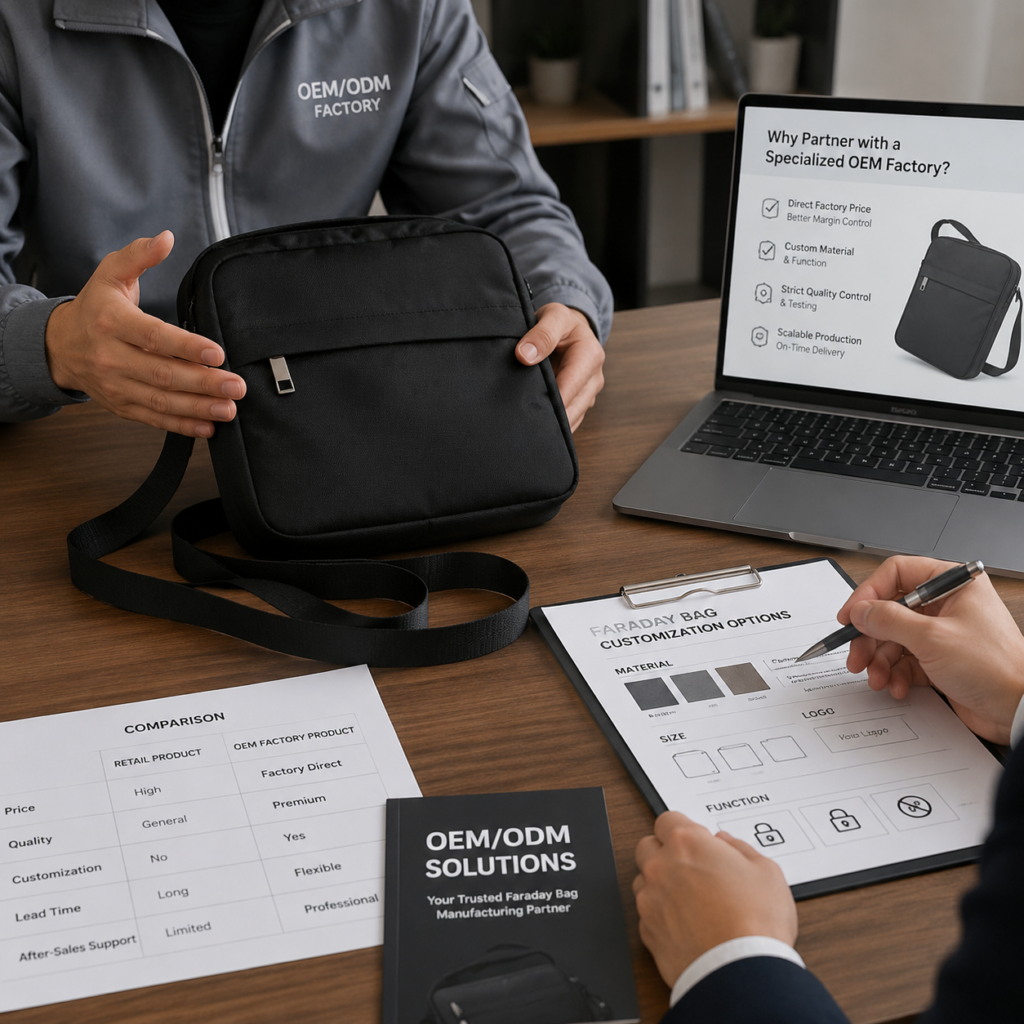
For professional procurement managers, relying on local retail distribution networks or searching for generic “faraday bags near me” is an inefficient sourcing strategy. Retail merchants carry generic, low-performance imports designed for basic consumer applications, packaged with steep markups that erode commercial margins. To scale a successful product line, buyers must establish a direct partnership with an experienced best faraday bag production facility, gaining direct control over material specifications and laboratory testing protocols.
9.2 Wholesale Red Lines: Understanding Total Cost of Ownership (TCO) in Security Gear
Direct factory procurement allows B2B buyers to optimize their Total Cost of Ownership (TCO) by eliminating intermediary markups and trading fees.
- Material Transparency: Verifying the actual weight and metal density of the conductive fabrics before assembly begins.
- Customization Efficiency: Adjusting internal dimensions, adding custom labels, and integrating specialized hardware at the factory floor level.
- Supply Chain Security: Securing consistent manufacturing lead times and scalable production capacity to smoothly meet seasonal retail demands.
10. Direct Sourcing Advantage: Why Partnering with a 26-Year China Bag Factory Saves Your ROI
10.1 The 30-Minute Hub Rule: Auditing Advanced Shielding Production Lines in Guangzhou Shiling
Our advanced manufacturing base is situated in Shiling, Huadu, Guangzhou—the undisputed luggage manufacturing capital of the world. Operating within this industrial cluster gives our factory a distinct logistical advantage, keeping us within a 30-minute radius of the primary raw material markets, hardware stampers, and independent testing facilities. International procurement managers attending the Canton Fair can easily conduct physical factory floor audits, bypassing virtual trading companies to verify our technical machinery and quality control capabilities in person.
10.2 Why an Expert OEM Bag Manufacturer Invests in On-Site Spectrum Analyzers
Quality control for functional safety bags requires specialized instrumentation. Our facility operates an on-site laboratory equipped with high-frequency spectrum analyzers and signal isolation chambers. We do not guess at performance; we test every material lot across the full 10MHz to 40GHz spectrum, ensuring that every batch of faraday bags meets strict international standards before packaging and shipment, protecting your brand from costly quality failures.
11. Customization Excellence: Integrating Faraday Cages into Fashion and Business Luggage
11.1 Cross-Functional Crossover: Merging Signal-Blocking Layers with Cut-Proof and Anti-Theft Textiles
The premium lifestyle market demands multi-functional products that address multiple security concerns simultaneously. We specialize in cross-functional integration, embedding advanced shielding layers directly behind physical anti-slash grids and cut-proof textiles. By combining our material expertise, we produce everyday business gear that provides physical protection alongside certified digital security, creating a unique product line that stands out in a crowded marketplace.
11.2 Flexible MOQs: Designing the Best Faraday Bag Lines for Emerging Privacy Brands
We provide flexible production tiers designed to support brand scaling without requiring excessive inventory overhead.
- Targeted Prototyping: Turning a custom design concept into a finished physical sample in under 7 days using our agile sample team.
- Scalable Production: Offering manageable minimum order quantities for complex customized designs, allowing your enterprise to validate new markets with minimal risk.
- Turnkey Excellence: Delivering certified, laboratory-tested best faraday bag inventory that establishes long-term brand value from the first delivery.

12. Conclusion: Securing Your 2026 Inventory Against Sourcing Traps
12.1 The Sourcing Matrix Checklist: Sourcing Evaluation Checklist for Signal Blocking Pouches
Before releasing capital for your upcoming security collection, run your production samples through this technical validation tool:
| Evaluation Parameter | Cheap Entry-Level Pouch | High-Quality Factory Shield | Sourcing Decision |
| Material Base | Aluminum Foil / Carbon Spray | Woven Ionic Copper-Nickel Cloth | Select Factory Shield for Flex Life |
| Tested Attenuation | 40dB – 50dB (Leaks sub-6GHz) | 80dB – 106dB (Full 5G Blocking) | Select Factory Shield for 2026 Spec |
| Seam Construction | Standard Polyester Thread | Silver-Plated Conductive Thread | Reject Non-Conductive Stitching |
| Closure Architecture | Single Flat Velcro Strip | Double-Fold Overlap Envelope | Reject Flat Hook-and-Loop Closures |
| Quality Verification | None / Generic Copywriting | On-Site Spectrum Analyzer Testing | Require Certified Lab Reports |
12.2 Contact Our Engineering Team for Certified Lab-Tested Faraday Prototypes
In the fast-moving digital marketplace, product quality is your primary brand shield. Partnering with a proactive manufacturer who possesses a deep understanding of materials science ensures your brand avoids supply chain bottlenecks and product line recalls. At Aimazing Bag, we provide the technical expertise, automated production lines, and strict quality control frameworks required to bring your security concepts to life. Contact our engineering team today to review our functional fabric options, request verified sample prototypes, and launch a market-leading privacy collection that sets the global benchmark for security and durability.