1. The 2026 Sourcing Paradox: Why Your “100% Anti-Cut” Inventory is Failing at Retail
1.1 The Illusion of Material Security: Understanding the Seam Vulnerability Crisis
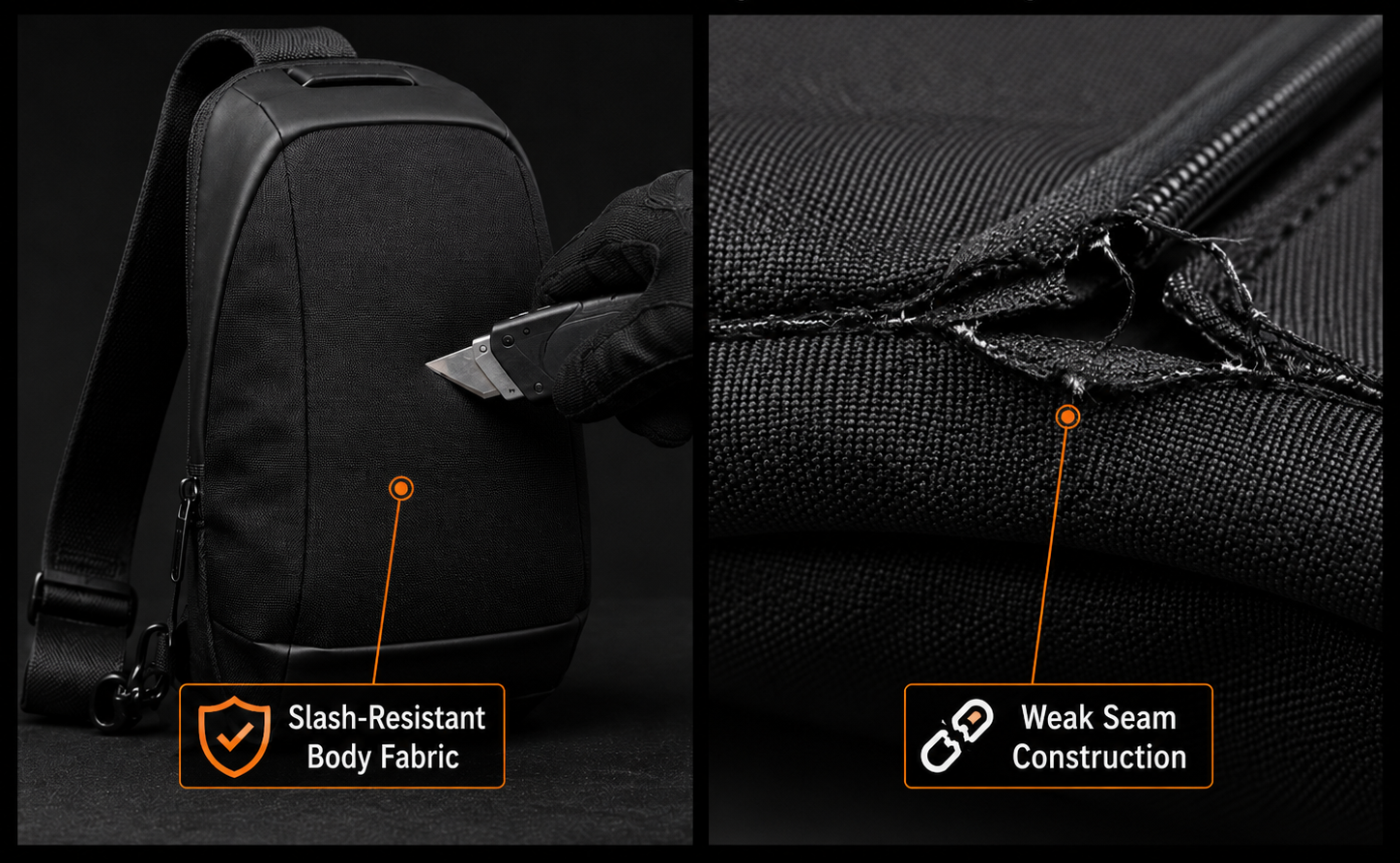
The global anti-theft luggage sector in 2026 faces a technical paradox where purchasing managers are misled by surface-level material specifications. Many brands invest heavily in high-performance structural fabrics like Ultra-High Molecular Weight Polyethylene (UHMWPE) and aramid blends but fail to audit the mechanical execution of their seams. A textile that successfully repels a direct blade strike remains an unviable commercial asset if the needle punctures create micro-structural stress concentrations that separate under tension. This discrepancy between fabric strength and structural integrity creates an internal failure point that manifests during consumer usage, resulting in severe brand erosion despite high upfront material expenditures.
1.2 The Reputation Avalanche: How Failed Seams Destroy the Credibility of an Anti Theft Cut Proof Bag
Distributing an anti theft cut proof bag inventory with unreinforced structural seams introduces severe commercial risks into an enterprise’s retail pipeline. Modern consumers share product failures instantly across digital e-commerce channels, turning a single split seam into a public relations crisis. When a commuter pack splits open under standard heavy loads or a minor snatch-and-grab attempt, the defensive marketing claim of the product is proven fraudulent. This failure triggers localized product returns, prompts mass order cancellations from bulk B2B distributors, and causes severe margin degradation that can permanently compromise a brand’s market position.
[Premium Anti-Slash Textile] + [Standard Needle/Thread Assembly] -> High Structural Friction -> Seam Failure under Load2. Material Science Meets Stitching: Why an Anti-Cut Bag Demands Specialized Engineering
2.1 The Mechanics of High-Tensile Fibers: Why UHMWPE and Aramid Resist Blades but Strain Stitches
The fundamental polymer science behind manufacturing a functional anti-cut bag requires a complete re-engineering of the standard garment sewing process. High-tensile fibers like UHMWPE display exceptional chemical immunity and cut resistance because their long, parallel molecular chains distribute transverse kinetic energy along the entire yarn length. However, this high molecular rigidity means the fibers lack physical elasticity along their longitudinal axis, preventing them from stretching to accommodate standard industrial sewing needles. When a traditional needle forces its way through an anti cut bag weave, it does not move the fibers aside; instead, it fractures the filaments, creating micro-shearing zones that act as tearing channels when the bag is under stress.
2.2 Micro-Tearing Under Pressure: How Wrong Needle Gauges Ruin a High-Quality Anti Cut Bag
The hidden flaw in many generic anti cut bags isn’t the fabric itself, but the seam execution. Standard polyamides cut easily under thread-to-fiber friction; therefore, a high-quality anti theft cut proof bag requires specialized bonded titanium needles, Japanese-imported high-tensile bonded nylon threads, and an internal UHMWPE bias tape wrapping to distribute stress loads up to 45 lbs without tearing at the stitch lines.
Using incorrect needle geometry or un-lubricated high-speed sewing tracks creates excessive thermal friction that weakens the polymer structures. Standard heavy-duty needles create large punctures in armored cloth, while high-tensile yarn friction creates micro-tears under the surface coating. To build a premium security pack, a manufacturer must manage needle heat and penetration pressure to ensure the structural weave remains uncompromised at the stitching line.
3. Unmasking the Flaw: 3 Ways Low-Cost Factories Compromise on Seam Integrity
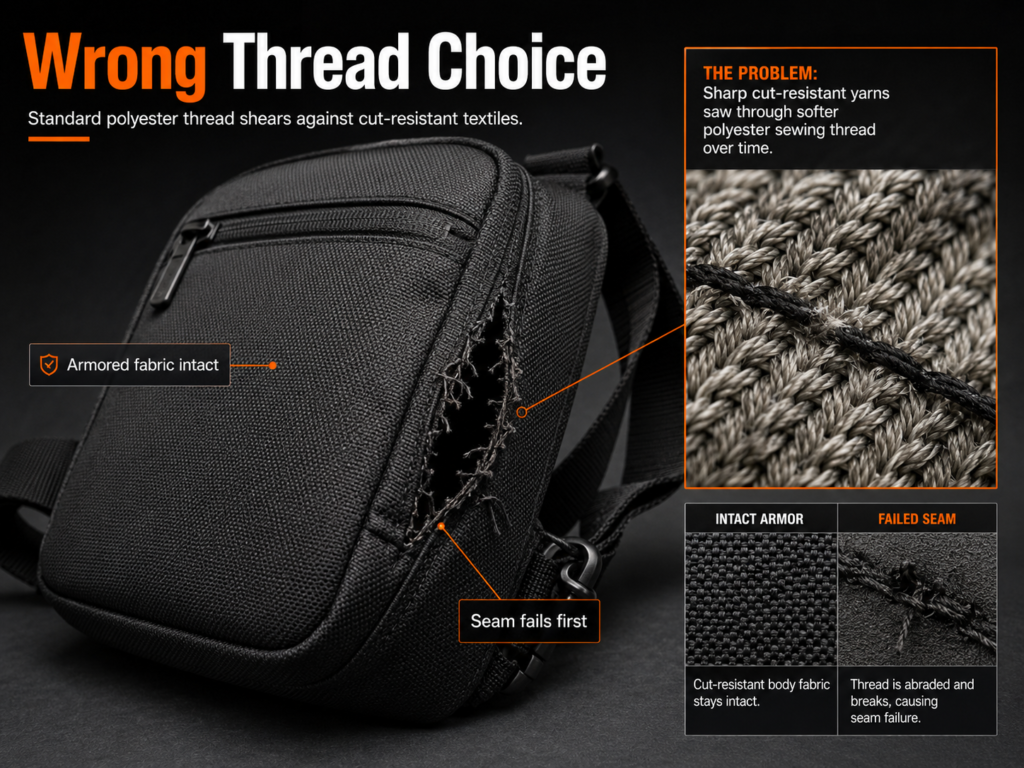
3.1 The Wrong Thread Choice: Why Standard Polyester Threads Shear Against Cut-Resistant Textiles
Low-tier production workshops often use generic spun polyester threads to assemble advanced security packs. This creates an immediate material conflict on the factory floor. When a bag carries heavy personal items, the sharp edge of the internal cut-resistant yarns cuts through the soft polyester sewing thread under dynamic movement. This micro-sawing action causes the thread to fail quickly, splitting the seam open even though the armored exterior panels remain completely untouched.
3.2 Skipping the Reinforcement: The Missing Boundary Tape inside Inexpensive Packs
To save on labor costs and raw materials, unverified suppliers omit internal edge-binding reinforcements. High-tensile fabrics require a structural stabilizer layer to prevent the yarn ends from pulling out of the stitch line under tension.
- The Structural Failure: Without an internal high-density bias tape wrapping, the cut edges of the armored panels slowly unravel inside the seam.
- The Result: The raw fabric edges slip right through the stitching loops, causing the bag to fall apart under load.
3.3 Density Deficit: How Improper Stitches-Per-Inch (SPI) Settings Create an Inherent Flaw
Finding the right Stitches-Per-Inch (SPI) setting for technical textiles requires precise engineering balancing.
- Too High SPI: Setting the density too high creates too many punctures close together, effectively perforating the fabric like a postage stamp and making it easy to tear open under load.
- Too Low SPI: Setting the density too low causes uneven load distribution, letting individual threads snap under localized tension. Low-cost factories often use incorrect SPI metrics, introducing structural flaws that cause premature failures under real-world usage.
4. The Weakest Link Exposed: Sourcing a True Cut Resistant Bag Strap
4.1 Steel Wire Inlays vs. High-Molecular Webbing: The Battle for Strap Longevity
The shoulder strap is the primary target during swift urban thefts, making the choice of its internal reinforcement a critical manufacturing decision.
- Stainless-Steel Inlays: Running multi-strand stainless-steel cables inside the strap edge provides excellent protection against heavy bolt-cutters, but can make the strap rigid, causing shoulder chafing over extended use and complicating assembly line throughput.
- High-Density UHMWPE Webbing: Utilizing pure woven UHMWPE inside a cut resistant bag strap maintains total textile flexibility while offering matching blade resistance. This ensures the strap remains supple, conforms perfectly to the user’s clavicle, and eliminates the stiff aesthetic associated with traditional anti-theft luggage.
4.2 Anchoring the Load: How an Expert OEM Bag Manufacturer Secures Strap-to-Body Joints
While trading companies only display videos of cut-proof fabric resisting blades, they avoid showing tensile pull-test data of the seam junctions. As a veteran OEM bag manufacturer with 26 years of experience, our facility utilizes an advanced ultrasonic welding process to fuse panel edges prior to stitching, reinforced with computerized heavy-duty Bartack Machinery that deploys double-box reinforced crossover patterns to distribute heavy stress loads cleanly without structural distortion.
5. Commuter Security: Engineering a Flawless Cut Resistant Crossbody Bag
5.1 Tactical Minimalism: Balancing Structural Safety with Urban Aesthetics
The urban menswear accessory market is shifting toward small-scale, high-utility carry solutions designed for daily city commutes. Developing a premium cut resistant crossbody bag requires a design philosophy focused on “Tactical Minimalism.” This architecture integrates hard-shell anti-slash properties within a slim form factor that sits tightly against the user’s chest, ensuring all primary zipper closures remain within the owner’s direct line of sight.
[Tactical Minimalism] -> Slim Crossbody Silhouette -> Compact Internal Zonation -> Low-Profile Theft Defense5.2 Seam Testing for Daily Carry: Simulating Snatch-and-Grab Scenarios in the Lab
To ensure real-world reliability in urban environments, our quality control labs subject every custom design to rigorous stress testing.
- Dynamic Drop Testing: We load the cut resistant crossbody bag with a 5kg weights and drop it repeatedly from a height of one meter to simulate sudden snatch-and-grab attempts.
- Pneumatic Tension Testing: Specialized pneumatic clamps pull against the structural seams to verify that the high-tensile threads do not cut through the armored panels under localized stress.
- Verifiable Security: This strict testing regimen ensures that every batch delivered provides long-term physical security, protecting your brand’s market reputation.
6. Breaking the “Ugly Security” Stereotype: The Rise of Cute Anti Theft Bags
6.1 Demystifying Fashion-Forward Security: Blending Soft Silhouettes with Hardcore Tech
For years, the anti-theft bag market was restricted to rigid, industrial-looking black or camouflage designs that failed to appeal to fashion-conscious consumers. The rise of cute anti theft bags has redefined this sector by proving that technical security can coexist with current lifestyle trends. We weave high-tensile polymer fibers into soft-touch fabrics like pastel jacquards, crinkled nylons, and premium vegan leathers, allowing brands to offer lightweight cute anti theft bags that blend into an everyday wardrobe while maintaining elite anti-slash performance.
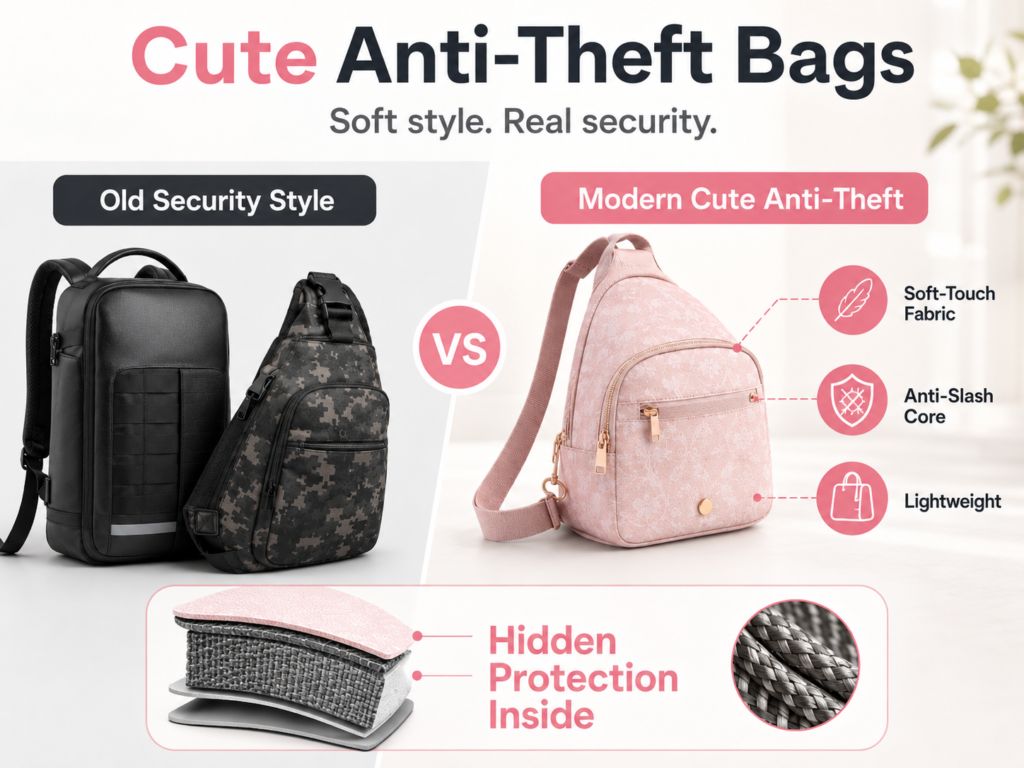
6.2 Why Premium Retail Brands Are Shifting Margins Toward a Cute Anti Theft Bag Portfolio
Retail brands are achieving excellent margins on fashion-forward security lines because they solve a critical lifestyle pain point with elegance.
- The Value Shift: Moving away from utilitarian gear toward a stylish cute anti theft bag collection lets brands target a high-net-worth consumer demographic.
- Chic Security: When a product looks like a luxury fashion accessory but performs like a high-tech armor shield, consumers are willing to pay a premium price, helping brands exit the discount-heavy retail cycle.
7. Gender-Specific Sourcing: Tailoring the Perfect Cute Anti Theft Crossbody Bag
7.1 Ergonomics for Her: Concealing Anti-Slash Layers without Bulky Outlines
Sourcing a dedicated cute anti theft crossbody bag collection requires a deep focus on material thinness and ergonomic distribution. Traditional anti-slash layers add bulk, resulting in awkward shapes that modern female consumers reject. Our factory solves this by using ultra-thin, high-density polymer sheets that provide certified cut resistance without changing the bag’s sleek silhouette, ensuring a comfortable, contoured fit against the body.
7.2 The Premium Premium: Why High-End Fashion Buyers Will Pay Double for Verified Seam Strength
High-end fashion buyers look for products that balance style with proven structural performance.
| Evaluation Metric | Generic Anti-Theft Pouch | Premium Engineered Crossbody | Sourcing Advantage |
| Material Thickness | Thick, rigid steel mesh panels | Ultra-thin, supple polymer layers | Sleek fashion silhouette |
| Seam Reinforcement | None (Standard single stitch) | Internal high-density bias taping | Zero structural sagging |
| Hardware Integration | Heavy, industrial metal buckles | Lightweight, color-matched closures | Cohesive luxury aesthetic |
By offering a verified cute anti theft crossbody bag that delivers high seam strength alongside elegant design, brands can command double the retail price of basic promotional gear.
8. Urban Mobility: Sourcing the Compact Anti Cut Cross Body Bag and Sling Pack
8.1 Active Commuter Engineering: Anti-Slash Protection for the Modern Micro-Carry Trend
The modern micro-carry trend has turned the anti cut cross body bag and the compact sling pack into essential gear for active city commuters. These compact carriers require high-density internal layout planning to secure valuable everyday essentials like smartphones, passports, and digital tablets within a minimal physical footprint, keeping your gear safe and organized during active travel.
8.2 Ergonomic Distribution: Why a Cut Resistant Sling Bag Needs Dynamic Stitch Flex
A professional cut resistant sling bag must be engineered to flex and move with the user’s torso during dynamic activities like cycling or running.
- The Tension Challenge: Rigid, unyielding seams concentrate stress at the attachment points when the user moves quickly.
- The Dynamic Solution: We use flexible polymer anchors and specialized zigzag elastic stitching techniques, allowing the anti cut bag core to stretch slightly under physical load without tearing the internal fabric panels or compromising the security shield.
9. Long-Distance Transit: The Architecture of a Reliable Cut Resistant Travel Bag
9.1 The Euro-Trip Sourcing Matrix: What High-End Travel Brands Look For in Safety Gear
Premium travel brands distributing lines across high-risk European tourism hubs look for products that balance clean corporate style with multi-tiered physical defense. Sourcing a premier cut proof travel bag collection for this high-end segment requires an internal core that can withstand both sharp utility blades and prolonged transit abuse.
- The Hardware Standard: Sourcing specifications for modern cut resistant bags for travel require integrated TSA combination locks and hidden anti-tamper zipper tracks to prevent rapid pickpocketing.
- Material Resilience: Utilizing a high-denier outer face fabric bonded to an internal high-ANSI polymer shield ensures the bag stays secure and professional-looking through long international flights.
9.2 Load-Bearing Realities: Preventing Structural Sagging and Seam Fraying in an Anti Cut Travel Bag
Large-capacity cut resistant travel bag models often face the issue of panel sagging and seam fraying when loaded with heavy travel gear.
- Internal Stabilizer Frames: We integrate lightweight, high-density polyethylene (HDPE) support structures into the base of our anti cut travel bag designs.
- Weight Distribution: The load-bearing handles and straps wrap completely around the circumference of the bag body, transferring the weight away from the seam lines to maintain a clean profile under maximum load.
10. The Ultimate Shield: Sourcing a High-Performance Cut Resistant Bag for Global Trade
10.1 Beyond the Knife: Ensuring Weatherproofing and Puncture Resistance Go Hand-in-Hand
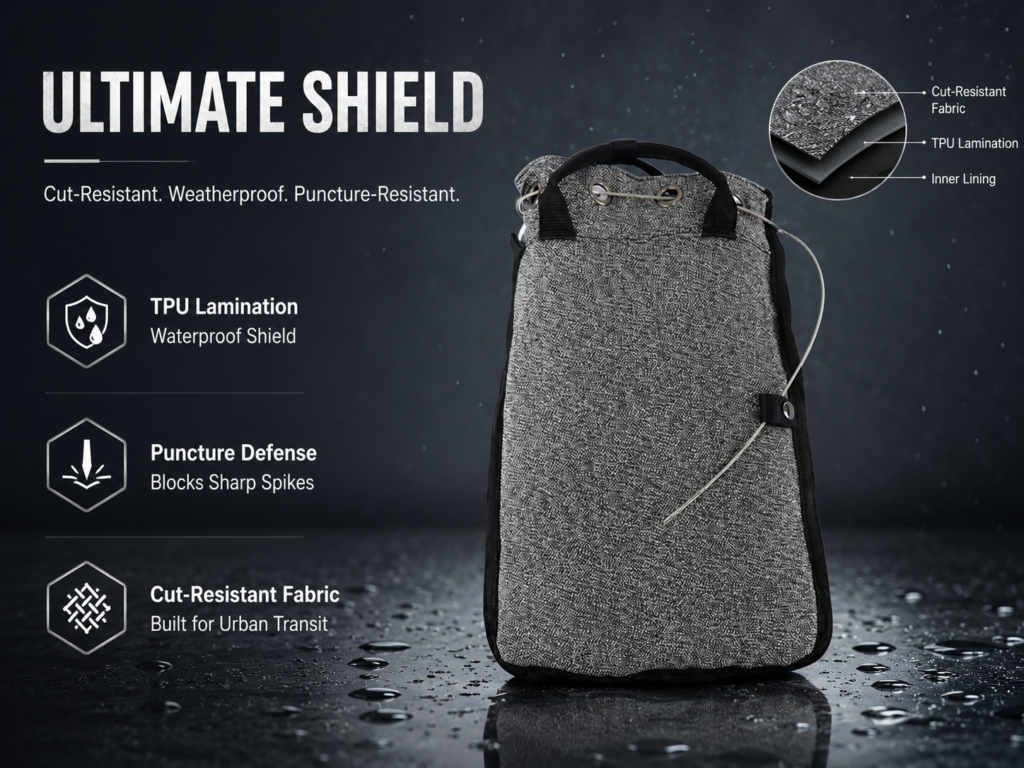
A truly premium cut resistant bag must protect its contents from multiple environmental threats simultaneously, ensuring water exclusion alongside raw slash protection.
- TPU Lamination: We bond a non-porous Thermoplastic Polyurethane membrane to the face fabric using high-temperature calendering, creating an external shield with verified waterproof ratings.
- Puncture Defense: This advanced lamination process yields a high-performance fabric layer that prevents sharp spikes or hypodermic needles from penetrating the weave, providing an essential layer of safety for modern urban transit.
10.2 Wholesale Quality Standards: Navigating ASTM and EN388 Cut Levels in Bulk Orders
Sourcing high-volume wholesale cut resistant bag orders requires a clear understanding of international safety certifications to protect your investment.
- EN388 Level 4: Verifies that the internal shielding layer can withstand repeated blade friction under consistent mechanical load.
- ANSI Cut Level A4: Confirms the material resists penetration from high-pressure knife strikes, giving B2B buyers objective proof of performance that justifies the premium product tier.
11. Cross-Functional Integration: Injecting Full-Scale Security DNA into Modern Backpacks
11.1 The Multi-Layer Defense: Merging Anti-Slash Seams with RFID & Faraday Signal-Blocking Linings
The modern high-end traveler faces a dual threat profile: physical theft of their assets and electronic hacking of their identity or car keys. Delivering a true premium product requires a cross-functional manufacturing approach that combines physical anti-slash layers with electronic defense shields inside a single pack.
- Faraday Cage Integration: We laminate nickel-copper conductive fabrics directly behind the anti-slash core in dedicated security pockets, providing up to 106dB of signal attenuation to block all wireless frequencies (5G, WiFi, Bluetooth, GPS).
- Comprehensive Protection: This hybrid approach is highly effective for protecting smart vehicle fobs from relay attacks, transforming a standard backpack into a comprehensive personal security ecosystem.
11.2 Manufacturing Complexity: Why One-Stop Factories Excel at Multi-Functional Fabric Laminations
Processing advanced high-strength fibers like UHMWPE alongside delicate conductive Faraday meshes requires specialized equipment that standard garment workshops do not possess.
- Avoiding Delamination: Combining different technical fabrics requires precise control over adhesive melting temperatures and pressure roll speeds to ensure the layers bond permanently without melting the functional components.
- Single-Roof Quality Control: Our one-stop manufacturing process handles every step under a single roof, ensuring consistent thickness and absolute quality control across every layer of the multi-functional fabric lamination.
12. Direct Sourcing Advantage: Why Partnering with a Verified China Bag Factory Saves Your ROI
12.1 The 30-Minute Sourcing Rule: Auditing Advanced Stitching Machinery in Guangzhou Shiling
Our state-of-the-art production base is situated directly in Shiling, Huadu, Guangzhou—the undisputed luggage manufacturing capital of the world. Operating within this world-class industrial cluster provides our factory with an unparalleled logistical advantage.
- The 30-Minute Advantage: Our facility is situated just 30 minutes away from the primary international trade hubs and Canton Fair exhibition halls.
- Complete Supply Chain Access: We source custom metal hardware, specialized technical textiles, and eco-certified linings in real-time, reducing prototyping times by weeks.
- Verified Quality Audits: International procurement teams can easily transition from a showroom meeting to a physical audit of our production lines, establishing an unassailable foundation of B2B trust.
12.2 Why a 26-Year OEM Bag Manufacturer Owns the Technical Tooling Cheap Factories Lack
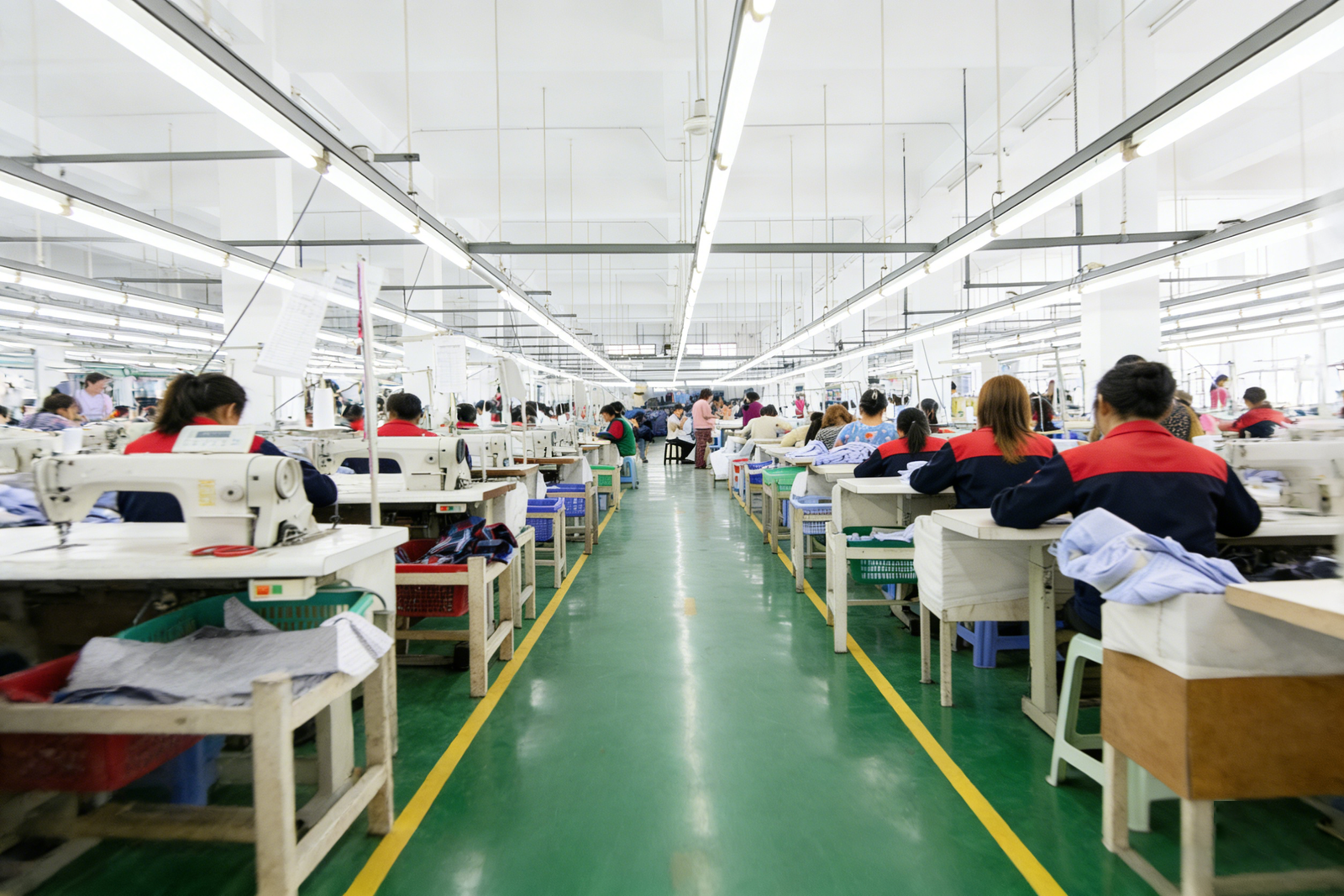
Processing high-strength technical textiles like UHMWPE requires heavy-duty industrial machinery that simple garment workshops do not possess. Woven polymer shields are incredibly tough on standard sewing machines, quickly dulling ordinary steel needles and causing skipped stitches or seam puckering. Our advanced manufacturing facility operates with high-torque computerized bartacking machinery and ultra-hard titanium-alloy needles, allowing us to handle dense polymer matrices cleanly, ensuring that every seam matches global quality benchmarks and protecting your supply chain from costly assembly delays.
13. Conclusion: Don’t Let Low-Quality Seams Kill Your Brand Reputation
13.1 The Sourcing Matrix: Anti-Slash Material and Seam Integrity Evaluation Checklist
Before releasing capital for your upcoming security collection, run your production samples through this technical validation tool:
- Is the material verified? Demand third-party laboratory test reports validating ANSI Cut Level A4 or EN388 Level 4 performance; do not rely on simple surface touch feel.
- Is the seam reinforced? Ensure all internal junctions are wrapped with high-density bias taping to prevent fabric unraveling under stress.
- Is the thread choice correct? Verify that the factory utilizes high-tensile bonded nylon thread rather than cheap spun polyester to prevent friction shearing.
- Are the joints? Confirm that all load-bearing handle and strap connections utilize computerized bartack stitching patterns to distribute kinetic energy evenly.
- Are cross-functional layers integrated? Upgrade your retail value by embedding hidden RFID-blocking layers or waterproof TPU laminations beneath the anti-slash panels.
13.2 Contact Our Engineering Team for Lab-Tested, High-Seam-Strength Prototypes
In a highly competitive international marketplace, your production partner must be more than just an assembly workshop; they must act as your supply chain guardian and engineering expert. Partnering with a proactive, 26-year veteran factory like Aimazing Bag ensures your inventory is protected against material fraud and assembly defects from day one. Contact our technical design team today to review our functional textile options, request verified sample prototypes, and launch a market-leading anti-theft collection that sets the global benchmark for security and durability.