As a specialist with 26 years of experience in high-specification functional bag manufacturing, I have witnessed the evolution of scent-containment technology from a niche requirement to a multi-million dollar B2B industry. In the current 2026 procurement landscape, the market is saturated with products that promise “scent-free” performance but fail within weeks. The core of this failure lies in the invisible internal architecture: the carbon lining. Many manufacturers utilize low-cost carbon-sprayed fabrics that offer a placebo effect rather than true molecular adsorption. For global brands, the difference between a high-margin success and a return-rate crisis hinges entirely on authenticating the quality of the activated carbon fiber (ACF) used in their supply chain.
1. The 2026 Sourcing Challenge: Why Genuine Carbon in a Smell Proof Backpack is Non-Negotiable
1.1 Beyond Aesthetics: How Fake Carbon Linings Damage Your Brand Reputation
In professional procurement, a smell proof backpack is an engineering tool, not a fashion accessory. When a buyer receives a shipment where the carbon is merely a decorative black coating, the scent-lock properties vanish after a single saturation cycle. This leads to catastrophic brand erosion; in the age of instant online reviews, a single batch of ineffective “scent-proof” gear can label a retail brand as “unreliable.” Genuine carbon ensures that the product performs its primary function consistently, protecting the end-user’s privacy and your company’s market standing.
1.2 The Science of Adsorption: Why Real Activated Carbon is Essential for Odor Control
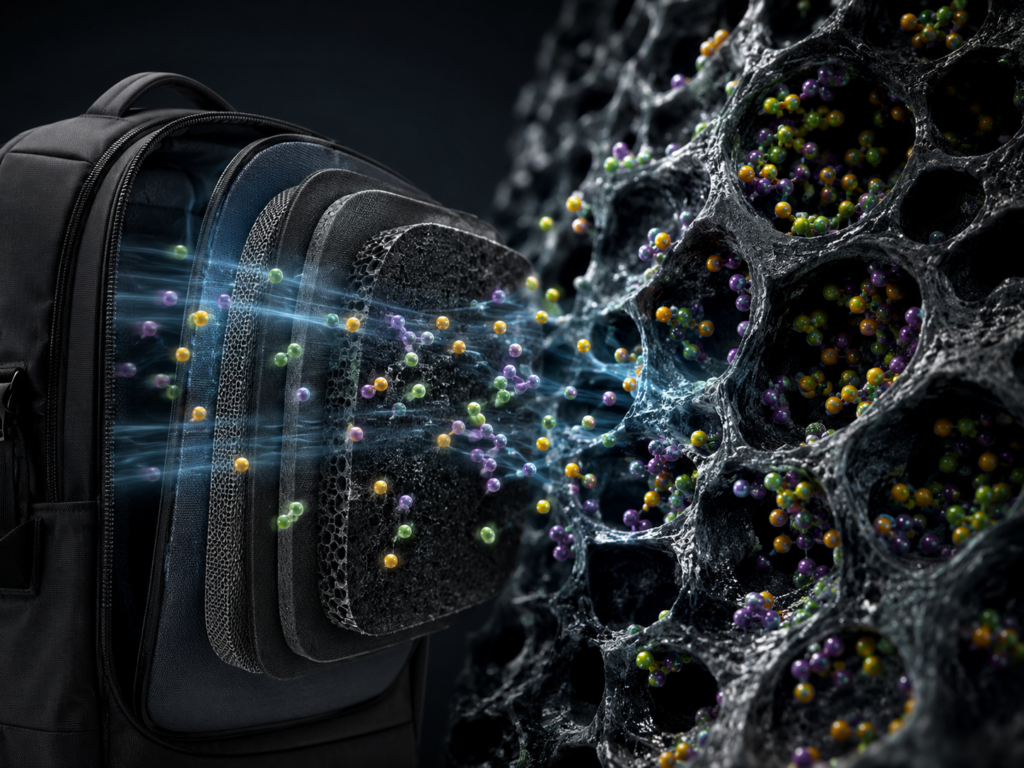
The efficacy of a smell proof backpack relies on the principle of adsorption—where gas molecules are trapped within the microscopic pores of the carbon. Unlike absorption (like a sponge taking in water), adsorption is a molecular bond.
- Specific Surface Area: High-quality ACF has a surface area of 1,000 to 1,500 square meters per gram.
- Micropore Volume: These microscopic “craters” are what actually capture volatile organic compounds (VOCs).
- Chemical Neutralization: Real carbon filters do not just mask odors; they physically remove them from the internal atmosphere of the bag.
2. Anatomy of the Best Smell Proof Backpack: Identifying Quality Linings
2.1 Activated Carbon Fiber vs. Charcoal-Infused Fabrics
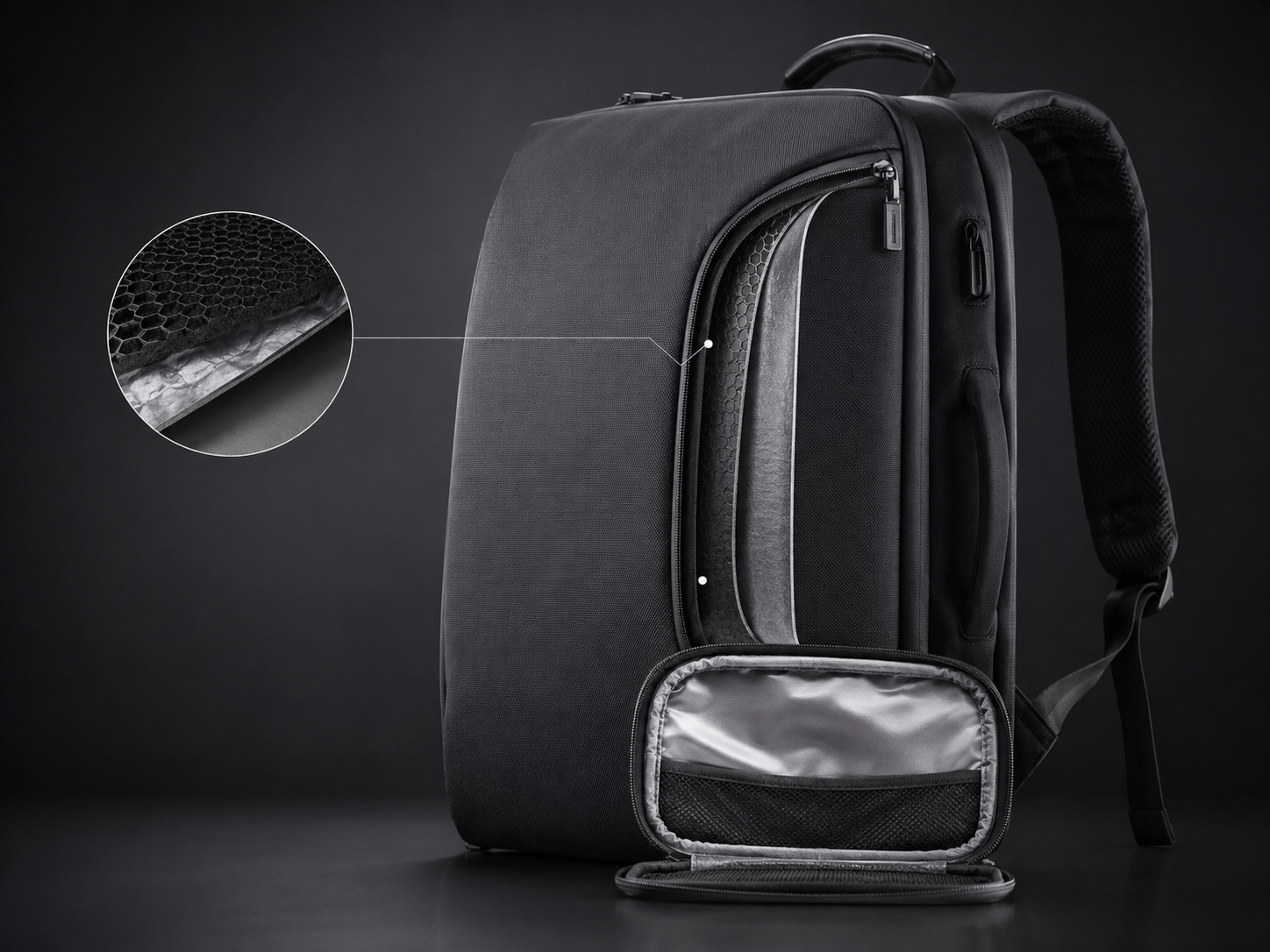
Identifying the best smell proof backpack requires a technical understanding of carbon variations. Many budget suppliers use charcoal-infused mesh, which is essentially fabric dipped in charcoal dust. This material lacks the structural density to provide a long-term barrier. In contrast, the best smell proof backpacks utilize multi-layered ACF felt, which is needle-punched to create a dense, impenetrable molecular wall.
2.2 Why High-Density Carbon Pores Define the Best Smell Proof Backpacks on the Market
The longevity of a bag’s effectiveness is determined by its iodine value—a measurement of carbon potency.
| Carbon Type | Adsorption Life | Pore Density | Sourcing Tier |
| Sprayed Carbon Cloth | 2-4 Weeks | Low | Entry-Level/Fake |
| Standard Carbon Felt | 3-5 Months | Medium | Mid-Range Retail |
| High-Density ACF | 12-18 Months | Extremely High | Professional B2B |
Authenticating the best smell proof backpack involves verifying that the supplier uses ACF with a high micropore volume, ensuring that the bag remains a “scent-free zone” even under heavy daily use.
3. Verification Method 1: The “Weight and Texture” Test
3.1 Why Genuine Smell Proof Backpacks Have a Specific Structural Weight
One of the quickest ways to vet smell proof backpacks is by analyzing the weight-to-volume ratio. Real activated carbon fiber felt is significantly denser than the thin polyester used in low-end imitations. A high-quality smell proof backpack should have a noticeable “heft” in the lining panels. If the bag feels suspiciously light and flimsy, it is highly likely that the “carbon layer” is merely a thin printed pattern or a low-micron spray-on coating that provides zero functional protection.
3.2 The Tactile Difference: Evaluating Carbon Density Through Fabric Feel
When examining smell proof backpacks, you should feel the lining through the outer fabric. Genuine ACF felt has a slightly “spongy” but firm texture, often sandwiched between protective mesh layers. It should feel like a distinct, thick layer of insulation. Fake versions often feel like a single piece of stiffened nylon. Professional buyers often use a “pinch test”—if you can feel the individual fibers of the outer shell meeting the inner lining with no structural core in between, the bag will likely leak scent within days.
4. Verification Method 2: The Saturation and Heat Recovery Test
4.1 How to Test if Your Smell Proof Backpack with Hidden Compartment is Actually Adsorbing
A smell proof backpack with hidden compartment is often used for highly aromatic contents, making the test of adsorption critical. To verify, place a high-potency scent source (such as essential oils or coffee grounds) inside the bag and seal it for 24 hours in a small, enclosed room. A genuine smell proof backpack with hidden compartment will leave the ambient air outside the bag completely neutral. If there is a faint “leak” at the seams or through the fabric, the carbon is either low-grade or non-existent.
4.2 The “Dryer Reset” Myth: Can Your Supplier’s Carbon Be Reactivated?
A definitive mark of high-grade carbon is its ability to be reactivated. Over time, carbon pores become filled with moisture and odor molecules.
- Heat Exposure: Placing a genuine bag in a dryer on low heat for 10 minutes can release trapped moisture and partially “reset” the carbon pores.
- The Test: If a supplier’s bag fails to regain its effectiveness after a low-heat cycle, the carbon is likely a one-time-use chemical coating rather than a reusable mineral-based filter. This is a critical factor for the long-term ROI of your inventory.
5. Verification Method 3: The Ultrasonic Seal and Zipper Integrity Check
5.1 Why Even Real Carbon Fails Without an Airtight Smell Proof Backpack with Lock
The best carbon in the world is useless if air can bypass the filter. A smell proof backpack with lock serves two purposes: security and seal compression. The lock pulls the zipper sliders into a fixed position, ensuring the overlapping fabric flaps (the “zipper garage”) stay closed. When sourcing a smell proof backpack with lock, check if the zippers are waterproof/airtight-grade. If air can easily flow through the zipper teeth, scent molecules—which are smaller than air molecules—will certainly escape.
5.2 Sealing the Scent: Evaluating Waterproof Zippers in Smell Proof Weed Backpacks
For the medical and botanical markets, smell proof weed backpacks must be hermetically sealed.
- Ultrasonic Welding: We utilize ultrasonic seams rather than needle-stitching in high-risk areas to eliminate microscopic needle holes.
- Rubber-Coated Tracks: In smell proof weed backpacks, the zipper tracks should be coated in matte TPU or PVC.
- Compression Flaps: Quality manufacturers include wide internal flaps that are forced against the carbon lining when the bag is closed, creating a physical “gasket” seal.
6. Market Focus: Analyzing Performance Standards for Smell Proof Backpacks for Weed
6.1 Regulatory Compliance: Why Discretion is Critical in Medical Markets
In 2026, the demand for smell proof backpacks for weed has surged in regions with legal medical frameworks. Discretion is a matter of legal compliance and social etiquette for patients. A weed backpack smell proof design must be completely opaque and scent-neutral to allow users to navigate public spaces without attracting unwanted attention. Professional B2B buyers must ensure their smell proof backpacks for weed meet “child-resistant” and “odor-lock” standards to qualify for high-end pharmacy and clinic distribution networks.
6.2 Structural Durability: Designing a Weed Backpack Smell Proof for Daily Commute
A weed backpack smell proof solution must withstand the rigors of a daily commute. This means the carbon lining cannot be brittle. Cheap carbon-sprayed fabrics crack when folded, creating “leakage paths.” Our manufacturing process involves bonding ACF to a flexible substrate, ensuring that whether the user is on a bicycle or a crowded subway, the structural integrity of the weed backpack smell proof remains intact.
7. The Logistics of Quality: Why Searching for a “Smell Proof Backpack Near Me” Isn’t Enough
7.1 The Fallacy of Local Retail vs. Direct Factory Sourcing
Consumers often search for a smell proof backpack near me when they need an immediate solution, but for a B2B buyer, local sourcing is the most expensive route. Local retailers typically stock high-turnover, lower-quality items where the “smell-proof” claim is a secondary marketing label. Direct factory sourcing allows you to audit the raw ACF material before it is sewn into the bag, providing a layer of quality control that a smell proof backpack near me search simply cannot offer.
7.2 Why Global Brands Source Directly from 26-Year Functional Bag Experts
Global brands avoid the “middleman markup” and technical uncertainty by partnering with experienced factories. With 26 years of experience, we provide a “Certificate of Authenticity” for our carbon grade. When you move beyond the smell proof backpack near me mentality, you gain access to custom sizing, proprietary hidden compartments, and laboratory-tested scent-lock technology that defines the premium segment of the 2026 market.
8. Advanced Features: Multi-Layer Defense in a Smell Proof Backpack for Weed
8.1 PEVA Linings and Foil Shields: Complementing Carbon Filtration
A high-performance smell proof backpack for weed does not rely on carbon alone. We employ a “Defense-in-Depth” strategy:
- Outer Layer: Heavy-duty 1680D polyester for abrasion resistance.
- Barrier Layer: PEVA or Aluminum foil to reflect radiant heat and slow down molecular diffusion.
- Core Layer: Dual-density ACF felt for active adsorption.
- Lining Layer: Non-woven mesh to protect the carbon and the contents.This multi-layer approach ensures that a smell proof backpack for weed remains effective even in high-temperature environments like a parked car.
8.2 Strategic Organization: Why Compartmentalization Enhances Scent Defense
Internal organization is a functional part of scent-proofing. By using a smell proof backpack for weed with dedicated internal pouches, the user can isolate the “hot” scent source from the rest of the bag’s volume. This limits the total amount of odor molecules that the main carbon lining has to process, significantly extending the life of the bag and ensuring the most sensitive items are protected by multiple layers of ACF felt.
9. Identifying a Reliable Factory Partner: Red Lines in OEM Production
9.1 Sourcing Direct: How a Smell Proof Backpack Factory Verifies Its Own Carbon
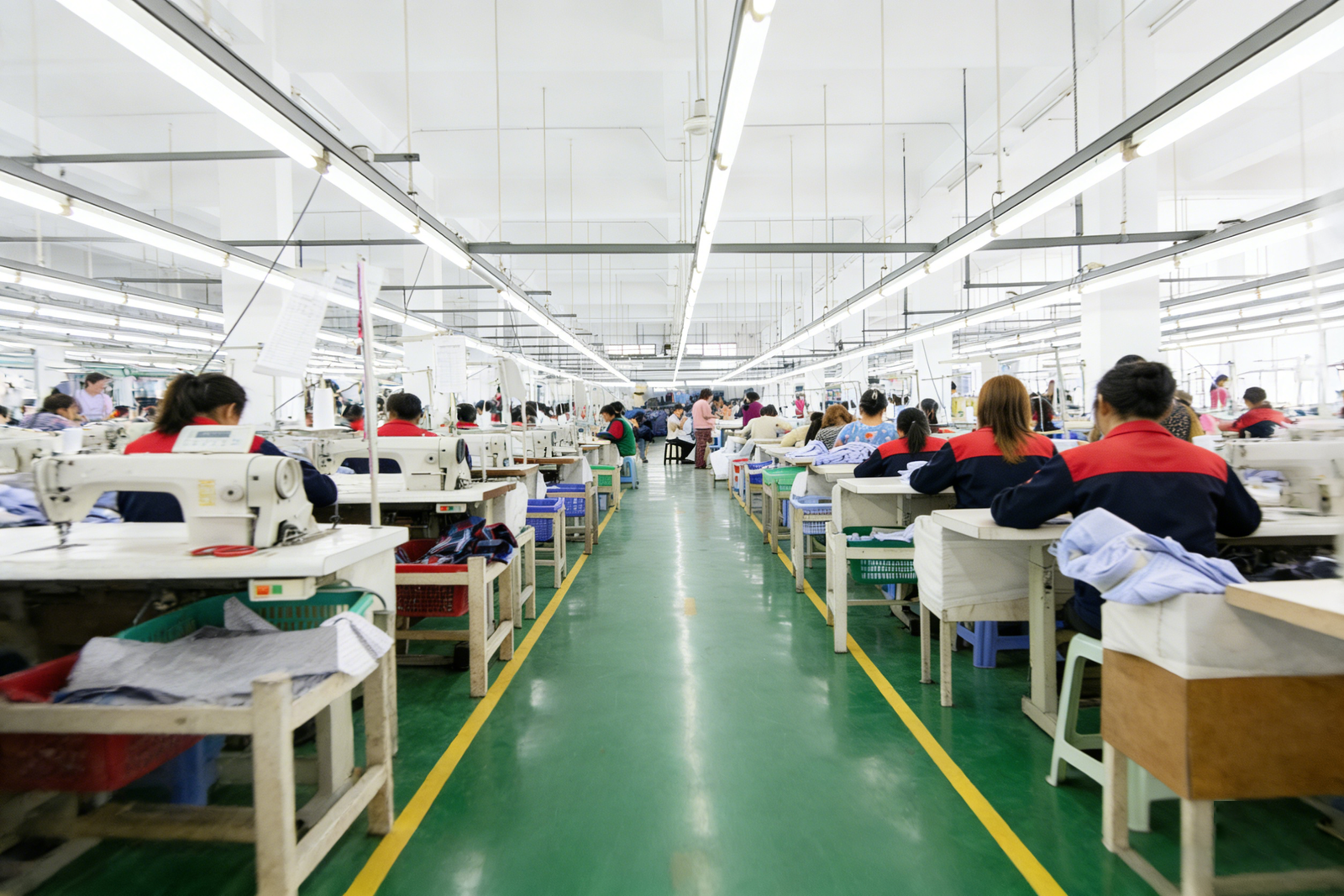
A reliable smell proof backpack factory must have an in-house laboratory. We don’t trust our suppliers blindly; we conduct our own iodine value tests and microscopic pore analysis on every roll of carbon fabric. As an OEM partner, a legitimate smell proof backpack manufacturer should be able to provide you with a video of the “Smoke Test”—where colored smoke is pumped into a bag under pressure to show that zero air escapes from the seams or the fabric.
9.2 Transparency in Manufacturing: From Lab Reports to Production Line Audits
When choosing a smell proof backpack partner, look for transparency.
- Material Lot Tracking: Every bag should be traceable back to the specific batch of carbon used.
- Third-Party Audits: Authentic factories hold certifications like BSCI or ISO.
- Live Inspections: Our facility is located just 30 minutes from the Canton Fair, allowing buyers to verify our production lines and ACF stock in person. This level of proximity is the best defense against traders who pose as manufacturers.
10. Conclusion: Securing Your 2026 Your Margins with Authenticated Quality
10.1 Why Investing in Real Carbon Saves Costs in the Long Run (ROI Analysis)
In the competitive B2B market, the cheapest smell proof backpack is often the most expensive to own. The cost of a 10% return rate due to product failure far outweighs the 15% premium of sourcing genuine ACF. By investing in authenticated quality, you secure higher customer lifetime value and eliminate the overhead of logistical recalls. High-quality carbon is not an expense; it is a margin-protection strategy for the 2026 fiscal year.
10.2 Final Checklist: 5 Questions to Ask Your Supplier About Carbon Grade
Before finalizing your next bulk order, ensure you ask your supplier these five critical questions:
- “Can you provide a laboratory report on the iodine value of the ACF used in this smell proof backpack?”
- “What is the total weight of the carbon lining relative to the bag’s total weight?”
- “Does the bag utilize ultrasonic welding for the scent-lock compartments?”
- “What is the recommended reactivation temperature for your carbon felt?”
- “Can I visit the production floor to audit the ACF felt storage and cutting process?”